How Workers Stopped Wars
22 October 2025
Donald Trump is on the hunt for a Nobel Peace Prize. He didn’t get this year, but after the ceasefire deal in Gaza he will be hoping for another chance next year. In the past many world leaders have wanted to take credit for the ending wars they themselves supported or instigated, often the same leaders who were responsible for starting them in the first place.
Henry Kissinger was a mass murderer responsible for countless deaths in South East Asia and the coup in Chile in 1973 yet won a Nobel Peace Prize. The “peace” between outbreaks of war just sees the rich prepare for the next round of violence. It’s not a real peace as long as their system is in place.
But there are examples in history of how the working class have been the driving force behind the ending of wars.
The most important example is the ending of the First World War by Russian revolutionary workers. The First World War, the first in history to result in such mass devastation and the death of millions of people, began in 1914.
Initially, workers in most of the countries involved were caught up in the nationalistic fervour whipped up by the ruling classes across Europe. The so-called socialist parties of the Second International were not immune to this war hysteria.
Despite a supposed commitment by the parties to internationalism and workers solidarity across national borders, in Germany the SPD voted in favour of the war credits. Other so-called socialists followed suit and there was a split in most parties between those who supported the war, and those who opposed it.
However, in Russia there were already two separate socialist organisations, the reformist Mensheviks and the revolutionary Bolsheviks. By 1917 the situation in Russia was at breaking point. Millions of soldiers were dying at the front, the workers and thier families were starving and the poor peasants were devastated. Under the slogan of “Land, Bread and Peace” a workers’ revolution broke out in February 1917.
The Tsar was forced to abdicate and reforms were promised by the new capitalist government. But with no sign of either land for the peasants, bread for the workers or peace, the revolution raged on. Workers formed their own democratic councils, or Soviets, and a power struggle between the revolutionary workers and the capitalist ministers raged on until the victory of the workers in an uprising in late October.
The new Soviet government, headed by the Bolsheviks, immediately began to work for the demands of the revolution. Ending the war came at a huge cost to the new workers’ state. In the treaty of Brest-Litovsk they were forced to give up huge amounts of land and territory to the Germans.
Particularly devastating was the loss of land in Ukraine, often called the bread-basket of Russia because of the vast amount of grains grown there. But the workers’ state had no choice but to agree to the terms set by the German imperialists. They had promised the workers and peasants peace and they had to deliver it. If it hadn’t been for the revolution and the workers taking power many more millions could have been killed in the horrific First World War.
Without the October Revolution the capitalist Provisional Government, set up after the February revolt, would have continued the war. The working class took Russia out of the war. But workers have not only stopped wars, they have also prevented their rulers from starting them in the first place.
For example in Sweden in 1905. Sweden and Norway had been joined in a political union since 1814. In the Kiel peace treaty Denmark relinquished Norway to Sweden and a political union was forced on Norway without the consent of the people.
In 1905 the relationship between the two countries came to a head and there was a referendum in Norway to dissolve the union. 99.95% of those entitled to vote voted in favour of ending the union (368,392 in favour to 184 against). The Swedish King Oscar II threatened to send Swedish troops to Norway to stop their declaration of independence.
But the Young Socialist movement organised against the invasion of Norway. Many of the soldiers that would have been sent to war were working class young men who were members of the Young Socialists. It became clear to the establishment that an invasion of Norway would be impossible.
The King was forced to abandon his attempt at war and sent the Prime Minister to negotiate the end of the forced Swedish “union” with Norway. Without the intervention of the Young Socialists, and its working class support base, it’s likely that there would have been a war between Sweden and Norway in 1905.
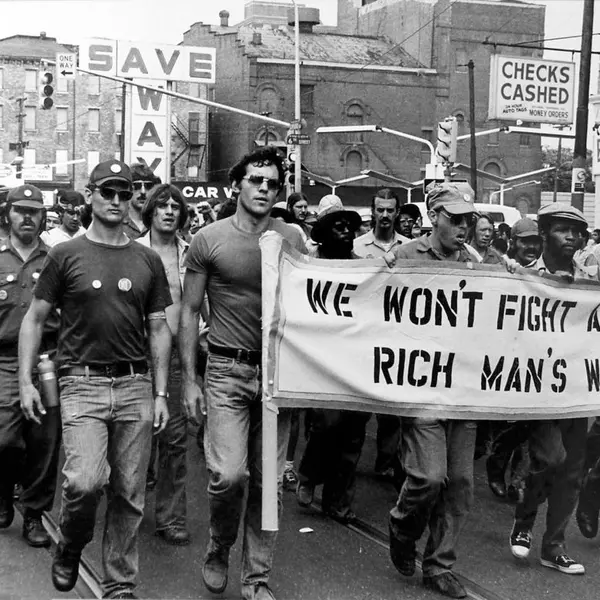
Workers have the power to stop and prevent wars firstly because it is workers who are drafted in to fight. They have the power to refuse to fight. Working class soldiers throughout history have found different ways of doing this from deserting, mutiny and draft dodging, to passive and active sabotage.
In Russia in World War I soldiers were deserting from the front in their thousands, especially after the breaking out of the revolution in 1917. They faced the death penalty if caught, but the conditions on the front were so brutal that they took the chance.
Sailors also have a long history of mutiny and revolt against their officers. In Germany in 1918 sailors in the German fleet refused to follow orders when they were being sent for a final battle with the British. The naval command were forced to stand down the attack after revolts by sailors on 4 ships in the fleet. After the arrest of hundreds of soldiers the working class of the port town of Kiel rebelled and started the German revolution.
Draft dodging is one way for young working class men to avoid going to war. It became common during the US war in Vietnam when over 500 000 young men fled to Canada and other countries to avoid having to go and fight. In recent years thousands of Russians have fled to avoid being drafted into the war against Ukraine.
Sabotage is another method of fighting back and was a common occurrence in Vietnam. It’s been reported that US soldiers often shot above the heads of the Vietnamese on purpose because they didn’t want to be there, but pressure from officers beat the humanity out of these soldiers and horror followed. Neither draft dodging nor sabotage counts as active opposition to war but both can play a role as passive methods of opposition.
Most importantly, the working class as a whole can stop war through the general power we hold over the economy, over production. Workers can shut down production of vital products and provision of services through strike action. Workers in the arms industry can stop production of parts and materials for arms, dock workers can refuse to load arms and service industry workers can refuse to carry out work associated with war.
In June this year French workers in Marseille refused to load machine-gun components made by arms manufacturer Eurolinks which were bound for Israel. Workers in Italy, Spain and Greece have taken similar actions in recent months. Here in Ireland in 1920, railway workers refused to transport British arms and soldiers during the War of Independence.
Also in 1920, dockers in London refused to load a ship with munitions sent to aid Poland’s war against the workers’ republic in Soviet Russia. In the service industry, actions can be small and largely symbolic, such as the Dunnes Stores workers refusing to handle Apartheid South African goods.
But even in those cases, they can become a catalyst for wider change. It’s not just workers directly involved in production or facilitation of war that have the power to stop wars. All workers have the power to stop wars because we have the power to shut down a whole country through a general strike.
This is what the working class in Russia did in 1917. They then took the next step by taking power into their own hands and organising their own government. The working class in power, and the building of a socialist society, is the only guarantee for peace and prosperity for the whole of humankind.
War is part and parcel of the capitalist system. The drive for profit comes before the welfare of human beings. Only workers have the power to stop this once and for all.
 RED NETWORK