Know Your Enemy: Cement Roadstone Holdings
13 March 2026
The Irish boss class are experts at hiding. It’s no coincidence that a country that came out from under the boot heel of an Empire, with the North still occupied, would have a capitalist class that can hide themselves so well.
For the vast majority of workers in Ireland, almost 1.9 million, the boss is Irish. There are globe spanning Irish corporations that suck profits out of workers here and all around the world. We Reds won’t let them hide.
Let’s look at one of the biggest Irish companies: Cement Roadstone Holdings.
CRH currently employs 83,000 people at 4,000 locations in around 30 countries, they’ve 47,000 workers in the US alone. They employ just 1,300 workers at home so most of their profit comes from exploiting an international workforce. In 2025 they returned $2.2 billion of that globally extracted wealth to their shareholders.
The company dates from the 1970 government backed merger of 2 companies: Cement Limited and Roadstone Limited. In 1933, the Fianna Fáil government under Seán Lemass (then Minister for Industry and Commerce) passed the Cement Act.
This Act empowered the Minister to grant manufacturing licences, to control imports and to authorize the compulsory purchase of land for cement factories and transport works. These measures led to the 1938 opening of Ireland’s first major cement plants in Limerick and Drogheda. These were owned by Cement Limited which had been established in 1936.
The Cement Act legislation granted this company a private monopoly over cement production in Ireland. They were protected by import restrictions that lasted for decades. Between 1932 and 1942, the Fianna Fáil government oversaw the building of around 130,000 houses. Contracts for these and later social housing projects established Roadstone and Cement Limited as the suppliers for most of the Irish state’s construction needs.
Roadstone (and later CRH) became the “essential partner” for the state’s transportation and infrastructure projects, providing the vast majority of aggregates and asphalt used in Irish roads for over 7 decades. Founded by brothers Tom and Donal Roche, Roadstone grew from a small sand and gravel business in the 1930s into the third largest company on the Irish Stock Exchange by the late 1960s.
It acquired the Belgard Quarry lands in 1968, which became one of the largest quarries in Europe. During the 1960s, it aggressively bought up other companies like Clondalkin Concrete and John A. Wood and also expanded into the British market by founding the concrete block subsidiary Forticrete.
It was Roadstone that launched the bid for Cement Limited in 1970. Fianna Fáil leader and Taoiseach Jack Lynch intervened to make sure that Roadstone was the preferred bidder for Cement Limited. Seán Lemass, Fianna Fáil Taoiseach from 1959 to 1966, became the first Chairman of CRH.
Lemass had credentials as a former 1916 rebel who had been on the roof of the GPO with a shotgun during the Rising and was only released because he was 17 at the time. It was these legends of former heroism that allowed Fianna Fáil to quietly build up an Irish bourgeoisie with expansionist ambitions.
In 1975, former Taoiseach Charles Haughey sold land back to CRH for a price that exceeded the initial cost of his entire Kinsealy estate. Roadstone Dublin Ltd insisted that the former chairman of CRH, Des Traynor, played no part in the purchase by the company of 17.5 acres of land from Haughey for £140,000 in 1973, which was disclosed at the Moriarty tribunal.
Haughey’s corrupt financial advisor, Desmond Traynor, was a director of CRH. They tried to appoint Haughey to a directorship but it caused too much controversy. Des Traynor was the architect of the so-called Ansbacher Affair, where the Irish rich could deposit cash with him in an office in Dublin while claiming the cash was abroad and exempt from tax.
In the mid-1980s John Cooke was hired by Hytherm, an insulation firm. They wanted to get an injunction against CRH to stop predatory pricing. When Cooke scored some legal successes CRH hired him to appeal an EU Commission decision of November 1994. The EU Commission had found that big cement producers and their trade associations, which included Irish Cement (a subsidiary of CRH) were acting as a cartel.
John Cooke accumulated tonnes of CRH shares from 1994 until 2010. Judge John Cooke went on to give 3 judgments in the Goode Concrete case and to strike out the Framus proceedings in 2012. Goode Concrete alleged that CRH engaged in predatory pricing. Framus Limited, Amantiss Enterprises Limited, and Wilbury Limited, all controlled by the Maye family, had taken a case about CRH’s cartel behaviour.
Cooke faced no action when his shares became public knowledge. He was merely criticised by the Supreme Court. But it wasn’t just in the home market where CRH were using every means they could to crush rivals and control markets. As we’ve seen in November 1994, the EU Commission had fined CRH plc subsidiary, Irish Cement Eco, €3.5 million for playing a lead role in a European cement cartel.
In the USA, CRH settled with Miracon Technologies in 2015 after Miracon accused CRH of patent infringement, breach of contract, misappropriation of trade secrets and fraud and conspiracy against defendants.
The “Port Dock” antitrust case taken against CRH concerned the supply of aggregates to the New York market. The case was struck out over legal technicalities. But the court had stated that: “in crafting the following summary of facts, the Court accepts all of the factual allegations in the complaint as true”.
In West Virginia CRH settled a price-fixing and market-sharing case with the State of West Virginia in October 2020 for $101 million plus costs.
In Poland the authorities fined CRH over $26 million for engaging in cartel behavior. In 2015, the Swiss Competition Commission fined CRH €32 million for its involvement in a price-fixing cartel in the bathroom fixtures industry. CRH is now embroiled in a legal battle in Ukraine over its attempt to acquire Dyckerhoff, a cement producer. Local regulators have raised concerns about an unfair market monopoly.
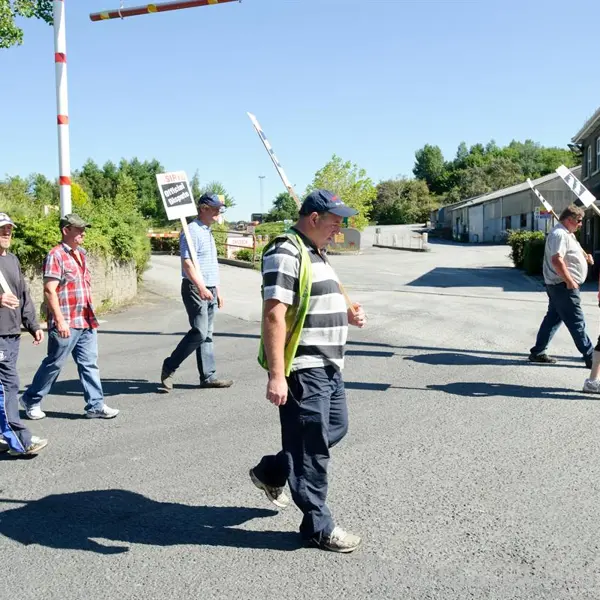
CRH have also been engaged in major battles with their workers both in Ireland and around the world. In 1970 there was a major strike by workers at Cement Ltd. The strike began in February 1970 and lasted for 22 weeks. The strike brought construction to a standstill and scab concrete was brought in from the North.
Vigilante squads of workers were formed to ambush lorries carrying “black” cement and firefighters in Newry showed their solidarity by hosing down and destroying smuggled cement. The deal that ended the strike was a Trojan Horse with union leaders handing over more control to managers and productivity increases in return for a staggered pay increase.
The Working Time Dispute of 1998 saw CRH face a test when the Working Time Act 1997 limited work to 48 hours a week. Around 700 workers threatened industrial action over compensation for reduced earnings resulting from new hours. A huge strike was prevented by a transitional arrangement that reduced workers’ hours.
There was a strike at Irish Cement 2012 with over 100 workers at plants in Platin Meath and Castlemungret Limerick striking for several weeks. Unions (SIPTU, TEEU, and Unite) accused the company of refusing to honour a non-binding Labour Court recommendation for compensation of between €5,500 and €9,500 per worker, instead proposing a 15–18% pay cut.
The Roadstone Woods Strike of 2014 saw approximately 350 SIPTU and TEEU members engaged in a 3 week long strike across 20 locations. The dispute was triggered by management’s attempt to cut payroll costs by €10 million over 5 years. It ended with a Labour Court recommendation to phase the restoration of bonuses.
Workers in other countries have also been fighting CRH management.
In 2020 CRH cement workers in Canada won a legal battle through their labour court, which ruled that the company could not use replacement workers during a strike. The conflict began in September 2020 when approximately 60 drivers and operators in Saint-Hubert, Quebec went on strike over pay parity and working conditions. CRH management locked out the workers and used scab labour.
A US CRH subsidiary, Oldcastle Building, agreed to pay $300,000 in back wages and interest to resolve allegations from the US Department of Labour. The company discriminated against female and African American applicants for glass worker positions in Georgia. Workers at the British CRH subsidiary Tarmac threatened strike action over a 3.75% pay offer.
The Ireland-Palestine Solidarity Campaign had also criticized CRH for its investment in Mashav, an Israeli holding company. This made CRH complicit in human rights violations and the construction of the West Bank Apartheid Wall, leading to a complaint filed with the OECD. In 2001, CRH acquired a 25% shareholding in the Israeli group Mashav Ltd which in turn owned Nesher Cement who built the wall.
They also don’t give a damn about poisoning the planet. In the early 2000s, CRH was accused of illegally dumping 100,000 tons of toxic waste in Blessington, Co. Wicklow. Household, commercial, and hazardous materials had been buried at the site over a 10-year period. The dump was discovered by Guards in late 2001 and Wicklow County Council admitted they’d been using the site too. The DPP pursued no charges against CRH.
The company pays its top staff well for all this exploitation. Albert Manifold was paid €12.4 million in his final year as CEO. His total retirement package was valued at approximately €67 million. They also use the profits they extract from the global workforce to buy political influence wherever they can.
Following the 2024 U.S. election, CRH increased its US lobbying spend to over $1.6 million. CRH also exerts significant influence through trade bodies, contributing approximately $20 million a year to groups like the Portland Cement Association and CEMBUREAU. These associations take far more aggressive stances against climate policies than CRH does publicly.
The vast majority of the value CRH creates comes from labourers in US quarries, Polish cement plants, and Philippine infrastructure projects. While CRH extracts millions globally, the Irish state is now spending over €2.2 billion to fix crumbling homes caused by defective blocks produced at home.
The Irish bourgeois aren’t just exploited workers here they are using their state to help them manage the exploitation of workers across the entire planet. The Irish state extracts a tribute from foreign multinationals stationed here in Ireland to fund the expansion of a globe spanning native bourgeoisie who are the foreign multinationals to workers everywhere else.
We need to unmask the Irish rich and set about building a movement to overthrow them.
 RED NETWORK