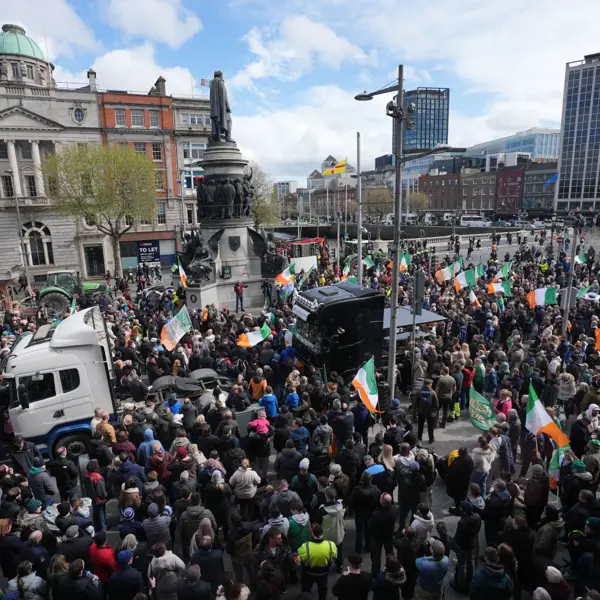
Fuel Protests: Workers Asking Where Are Our Unions?
14 April 2026
The recent fuel protests by hauliers and farmers showed workers what can be achieved by people power as agricultural contractors, farmers, hauliers and private bus companies temporarily shut the country down and got offered a €750 million package in return.
Yet us ordinary workers are forced to fight with one hand tied behind our backs. When energy prices surged following the war in Ukraine and private companies fleeced workers the union leaders defaulted to slow negotiations with the Government which lasted months. They took no action.
They negotiated for wage increases for public workers that were far below inflation, in effect a real pay cut. Less than a week after contractors, hauliers and farmers began blocking roads they were offfered €750 million in excise cuts, subsidies and a carbon tax increase was to be postponed.
ICTU has 800,000 workers as members of the affiliated unions. We have much greater power than the farmers and contractors because we are on the inside of thousands of workplaces and can shut the whole economy down. But ICTU won’t use that power. They could at minimum call a water charges scale protest on fuel now.
But our union leaders have been stuck in a bubble of “social partnership” for the last few decades and they use the 1990 Industrial Relations Act as an excuse to stand back and do nothing. Under the act workers can be jailed for not following a long, drawn-out process to settle a dispute.
Pickets like the Debenhams picket are broken by Guards while worker occupations like at Thomas Cooks see the state mobilise to remove workers. But breaking a regressive law depends on numbers. It’s as simple as that. Most people didn’t pay their water bills and the charges had to go.
The effect of unions bowing to the 1990 act is obvious; companies can go on exploiting workers with no recourse and by the time a dispute is settled workers are completely drained and demoralised. Look at the recent school secretaries and school caretaker strike. The union leaders spoke out against SNA’s joining pickets in defiand of the 1990 act.
The workers had the upper hand when schools were threatened with closure but the unions capitulated for the mere promise of “talks.” There was no guarantees from the government side, and it has not been resolved 7 months later. The offer of talks was a ploy to dupe workers into dropping pickets.
Growing union militancy and mass strikes by workers in the 60’s and 70’s led to the Industrial Relations Act 1990. It was made law on the 18th of July 1990 which was nearly 6 years to the day after Mary Manning and other Dunnes Stores workers were suspended for refusing to handle Apartheid goods. The 1990 act controls what workers can do during a strike.
It restricts where pickets can be located, bans workplace sit-ins, bans solidarity strikes and added extra steps in the process to legally strike including a 7 day notice period. If you don’t follow any of these rules workers can be arrested and unions can be liable for financial losses.
It completely took back power from workers who were gaining in confidence threatening a society that funnelled all the wealth produced to the top. Strikes, pickets and sit-ins have a long history in Ireland and have shown workers they can be used to make the bosses and government give in to our demands.
36 years later: Ireland ranks 3rd for wealth inequality in the EU. Ireland is the 2nd most expensive country to live in the EU and 17,300 people are homeless. Wage growth is historically low while productivity is at an all-time high.
The act also gave trade union bosses an excuse to hold back the revolutionary power of workers. They had a piece of paper to get them out of any jam and could lead workers down a merry path of endless talks and mediation. Officially ICTU and our various unions oppose the Industrial Relations Act but ICTU officials were involved in consultations along with IBEC when it was being drawn up in the 80’s.
They want to be seen as a trustworthy partner for employers and the government and often end up doing their bidding, repeating their line that whatever pathetic deal offered is “the best we can hope to get.” Solidarity strikes are banned under the 1990 act and this means that other workers are legally forced to cross a picket.
We have seen this in recent years in strikes such as the nurses in 2019 and school secretaries in 2025 and the power is completely taken out of the strike. During the secretaries strike when SNA’s began refusing to cross the picket Fórsa leadership was on the RTÉ Six One news that evening castigating SNA’s for their solidarity and said that they should work as normal.
Union official Andy Pike finished his message saying that it would backfire on the secretaries and caretakers. It was a serious threat and here was the union running a strike doing the job of the government and disciplining other workers for standing up for their friends and colleagues!
The unions always point to the fact that they are the only ones the employers and government will talk to in a dispute but we have seen this week that when people shut down a port the government will make concessions.
Workers have been feeling th pain the last few years and watching farmers, hauliers and business owners shutting down the country this week has left workers frustrated at our unions just sitting it out on the sidelines. The Irish Congress of Trade Unions has 800,000 members and has called no actions on fuel or on the cost of living. A major protest of tens of thousands of workers should be called right away.
The port blockades were eventually moved by the state forces but workers are on the inside of the economy driving it forward everyday and we can shut everything down in an instant. We have all the economic power of this country in our hands but are held back by a leadership afraid of militancy and afraid of genuine change.
If a few hundred farmers and hauliers can shut down the country imagine what 800,000 unionised workers could do if we weren’t fighting with one hand tied behind our backs? The government parties and their 14,000 Gardaí attack dogs would be no match for us.
We are always fighting with one hand tied behind our backs as long as the wealthy suits are in charge of our unions and the 1990 Industrial relations Act is in place. In the short term we need to demand ICTU call mass protests on the cost of living, on fuel and on housing but socialists also need to do the patient hard work of building up a network of revolutionary workers across every union to encourage grassroots workers to challenge the bureaucratic leaders and force a fight in the interests of our class, the working class.
 RED NETWORK