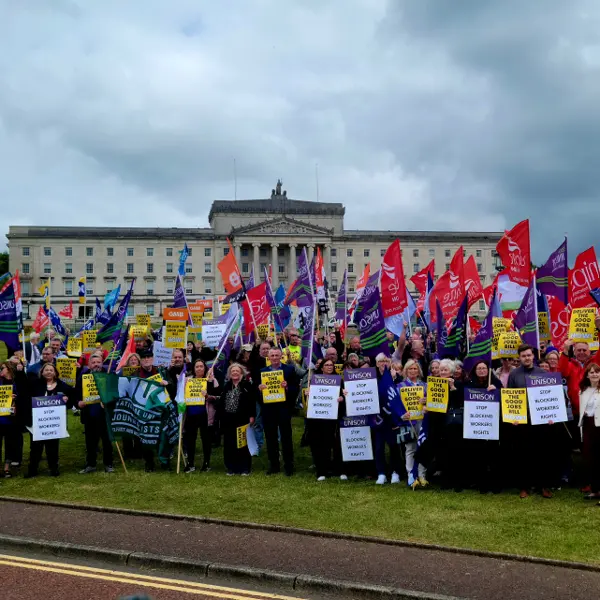
Bosses Want To Kill The Good Jobs Bill
19 May 2026
349,000 people in the North of Ireland are living in poverty. Two-thirds of these people are workers currently in work. This is the starkest evidence yet of the impact of the cost of living crisis on working-class communities. A crisis now made even worse by fuel shortages resulting from the US-Israeli war against Iran.
Hope of any relief is at an all-time low. Only 1 in 4 people believe that Stormont has improved their lives since its restoration in 2024.
It is now two years since the so-called “Good Jobs Bill” was first announced by Sinn Féin Economy Minister, Caoimhe Archibald. This group of measures was aimed to bring about “the biggest upgrade in workers rights since the Good Friday Agreement.”
The proposals included:
- An end to exploitative zero hours contracts
- Ending the practice of “fire and rehire”
- Paid leave during neonatal care
- More protections for agency workers
- Stronger trade union rights
- Stronger rights for flexible working
- Ensuring workers can keep the tips they earn
These are not radical demands. In fact these changes would bring workers rights in line with the rest of the UK. And unlike Scotland and Wales, Stormont actually has the powers to change employment law.
There has even been clear public support from voters of all the Assembly parties. Nothing was standing in its way. The bill was due to be introduced to the Executive in December 2025. Yet here we are, six months later, and it is nowhere to be seen.
This is likely due to significant pressure from business groups, including the Confederation of British Industry (CBI) and NI Chamber of Small Businesses. In a letter to ministers they claim: “We are increasingly concerned that we are running out of time to ensure that full and proper scrutiny can be given to the bill, or indeed, any potential amendments.”
This is nonsense. There is still a full year until the next Stormont election. The continued delays to the bill prevent it from being moved forward, where it can be read in the Assembly and debated in public. It is being denied scrutiny. If it is not passed before March 2027, the bill will fail. It doesn’t take a detective to see that this is their aim.
It is clear that these business groups are not concerned about proper scrutiny or “unintended consequences.” Their real concern is the possibility of increased rights for trade unions. The DUP’s own criticisms confirm this.
The bill proposes lowering the trade union recognition threshold in workplaces from 21 employees to 10. This could have a huge impact on workers in the private sector, and help them to negotiate fairer contracts with their employers. While 80% of public sector workers in the North are on contracts that were collectively bargained through trade unions, only 20% of private sector employees can say the same. This legislation could go a long way towards correcting this imbalance.
Additionally, the bill would give union representatives the right to request access to a workplace, even if they are not recognised in that workplace. This increased oversight could also prevent employers breaching workers rights and lessen workplace exploitation.
These bosses’ groups go on to claim that passing the Good Jobs Bill will be harmful to the economy as a whole. That it will negatively impact both businesses and workers. They tell us we’re all in the same boat in the cost of living crisis and that the current “economic recovery” is too precious to risk. This too is nonsense and quite frankly insulting.
The top 100 companies in the North have made £1.8 billion over the past two years. Meanwhile around 232,000 workers languish in poverty. They work hard and still struggle to make ends meet, many enduring zero-hour contacts in jobs that should have regular hours. Their shifts can change at a moment’s notice. And, at the end of the shift, they are not even entitled to keep the tips they earned.
The class interests of bosses and workers are directly opposed to one another. The fact that even small demands are too much for the boss class should make this obvious. Let loose, they will squeeze every penny they can from their workforce and fight even the smallest attempts to loosen their grip on workers.
The Good Jobs Bill is the latest battle in the long line of working class struggle. Unions have made it clear that they want to fight on this. We must continue to apply pressure on the Assembly - and on our unions if they start to retreat - if we are to win even these basic reforms.
However, while we at the Red Network welcome any small improvements to the everyday lives of workers, the hard reality is that these reforms alone will not end worker exploitation. What is given can always be taken away.
Nothing is secure until workers have political power.
Look no further than the NHS. It has endured decades of sustained mismanagement and underfunding. All with the aim to force patients to go private and make healthcare another source of profit, rather than a social need. Imagine if the NHS was run by workers?
Only by putting workers in the driving seat through the overthrow of capitalism, ending private ownership in the economy, can we truly bring the changes we need and deserve.
We must continue to link the fight for reforms with the end goal of putting workers in control of a planned economy, directed at improving the lives of the many, no longer creating profits for a few. Only then can we free ourselves from workplace exploitation, end poverty and finally deliver on the promise of “good jobs.”
 RED NETWORK