Mamdani’s Grocery Stores Offer Subsidies To Bosses
5 August 2026
Working class people in Ireland are being crucified by the cost of living crisis. According to St. Vincent De Paul, approximately 484,200 people were in food poverty in Ireland in 2024. 10% of parents rely on food banks and about 29% of lower-income parents report regularly cutting their own portions or skipping meals so their children have enough to eat.
It’s no wonder so many people have latched onto New York’s new subsidised groceries as the way to go. The suggestion of state-owned shops has created a debate across the globe about how we can best take on the market and provide cheap goods for hard-pressed workers.
Since New York Mayor Zohran Mamdani announced he’d set up state-run grocery stores there’s been a flurry of attacks on the idea from the pro-capitalist press. That’s no surprise. They hate the idea of anyone interfering with the market. But Mamdani’s proposals don’t really take on the market.
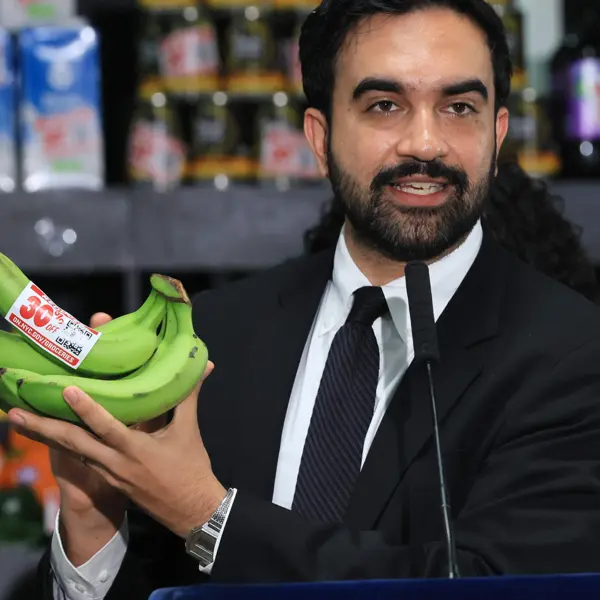
Firstly, they’re not really state-owned grocery stores. “NYC Groceries” will be run by private companies who will have their rent and property taxes paid by the state allowing them to offer certain basic goods at a 30% discount while still making a profit.
If a working class family in New York can buy food 30% cheaper in a few months, that would be a real gain. Working class Marxists are not opposed to workers paying less for food. The key question is whether reforms that leave overall food production in capitalist hands can survive long-term without capital eventually clawing them back?
The New York City Economic Development Corporation has just issued a 44 page document looking for private businesses who want the Mamdani contract. The private operators have to establish a 30% discount on essentials like meat, seafood, milk, and bread. They also have to offer decent jobs with benefits.
The capitalists running the discounted shops will have their profit margins guaranteed by the state and if the rent and property tax overheads being removed isn’t enough for them to drop prices by the required 30% they’ll get subsidies from the state.
The stores won’t sell cigarettes, beer and lottery tickets as small shops have kicked up a fuss over competition. Mamdani himself insisted that his stores will go out of their way to avoid harming private competitors.
Capitalists can easily squeeze the city for more. If big agricultural monopolies raise their wholesale prices, the city’s “affordability payments” will have to go up to maintain the 30% discount.
If the city decides to buy from smaller farmers, who have to charge higher prices, the subsidies would have to increase. Public money would just end up guaranteeing private profits. We’ve seen this in Ireland with HAP subsidies to landlords. It helps some tenants but also does nothing to bring down overall market rents.
Setting up just 5 stores cannot possibly sell enough food to make an impact for the 8.5 million people living in New York. It also cannot change the production and sale of food.
Mamdani wants to create a small island of low prices in a sea of higher market prices. This means that the city will have to police the poor because this island of low price goods can be sold on at prevailing higher market prices. General inequality and the gap between the subsidised prices and market prices will create a massive incentive to sell on.
So Mamdani’s had to introduce some form of ration card to make sure when poor people leave this island of cheap goods and return to the horrors of the wider US economy they don’t sell on the cheap groceries. The exact details of the ration card are being left up to the private operators to work out.
But Mamdani is fearful of tracking poor or homeless people and has insisted that anyone can just walk in and request a card if they need one. But what’s to stop someone going to the 5 shops and getting 5 cards? Nothing.
Mamdani is attempting anonymized rationing. He is telling the private store operator to enforce caps on each card, while also insisting that they cannot verify who holds the card because he’s afraid of policing the poor. But the need to police the poor stems from the untouched capitalist sea raging outside the little island of his 5 shops.
He’s not asking why prices are high in the first place. His scheme accepts market prices. Many grocery stores might make a high mass of profit by sheer volume of sales but the percentage rate of profit is lower than many other industries because profit is extracted all along the supply chain.
Mamdani is trapped by his refusal to take on the wider system. This is key to understanding his politics. He said that he was interested in “the politics of collaboration” in an interview with Stephen Colbert.
In an interview with the New York Editorial Board he said: “My ability to build coalitions across the political spectrum is one that would serve our city well.” He told the New York Times that he was in favour of the private market in housing and said “I clearly recognise that there is a very important role to be played and one that the government must facilitate.”
Mamdani talks about reform on the one hand and on the other tells the New York Editorial Board that he’ll be “fiscally prudent”.
While he’s trying to tempt private companies to run the 5 discount New York grocery stores control over wider food production remains with capitalists. They will use the power this gives them. Venezuela’s state-run grocery networks, Mercal and PDVAL, are a good example of how capitalists can sabotage a state that tries to create small islands of progress in a capitalist sea.
Because the state didn’t control the farms or the key factories across Venezuela, private bosses engaged in an intentional slowdown. They cut production, hoarded ingredients in their private warehouses, and they allowed products like milk to go off rather than sell them on to state distributors.
Corrupt private distributors, private store owners, and desperate citizens realised they could buy subsidised goods at Mercal for low prices, smuggle them for sale across the border in Colombia, or resell them on the black market for a 500% profit.
You cannot create islands of lower prices in a system where capital still has overall control. This will combine with general inequality to create a market for the subsidised goods. Not to mention greedy small shop owners who’ll stock their shelves with the cheap goods if they can.
Here in Ireland People Before Profit have jumped on the Mamdani proposal but want to fund it through a Public Nutrition Levy on the profits of the fast food industry and larger food retailers. More taxes on greedy is a good idea. This is at least a step beyond Mamdani’s fear of touching profits.
But if private supermarkets dominate the market they will simply pass the tax on through higher prices, then taxing them doesn’t solve the wider problem, it just confirms that they still control pricing. If they can’t pass it on because competition prevents it, then their profits fall and they will intensify pressure elsewhere - on suppliers and on workers’ wages.
Either way, the underlying ownership of the food system remains unchanged, some workers (who are entitled to lower prices) get some goods cheaper but the wider working class would be made to pay for it under any incarnation of the current system.
If this is a proposal for the current system then it will fail. Fianna Fáil or Fine Gael have no interest in it. And Sinn Féin would want it watered down to keep business happy. If it’s a proposal for socialism then why just state-run grocery stores? Surely workers would control the whole of food production?
There’s a real lack of clarity here. To be clear, we are for any reform that makes life better for other workers. But it’s about securing those reforms with struggle and continuing the fight until power isn’t in the hands of people who can overturn any progressive moves we try to make.
The key question is control. Who controls the production of food? We need a state-run food industry, under the democratic control of workers. To get there we need a state that’s under the control of workers. That would require a rebellion against the current system. To get that we need to put workers in the driving seat of our trade unions and fight.
If you don’t control supply chains, capitalists will sabotage you. If you don’t control the state, reforms are simply overturned once struggle drops. In the short term, we need a generalised fight for higher wages across the board. A generalised increase in wages would bring down all prices relative to wages.
Every good would be relatively cheaper. Profits would take the hit and prices would fall. But that’s not enough. The bosses always fight back and they control the state.
We need to put workers in the driving seat of a planned economy where no one ever goes hungry because of corporate greed.
 RED NETWORK