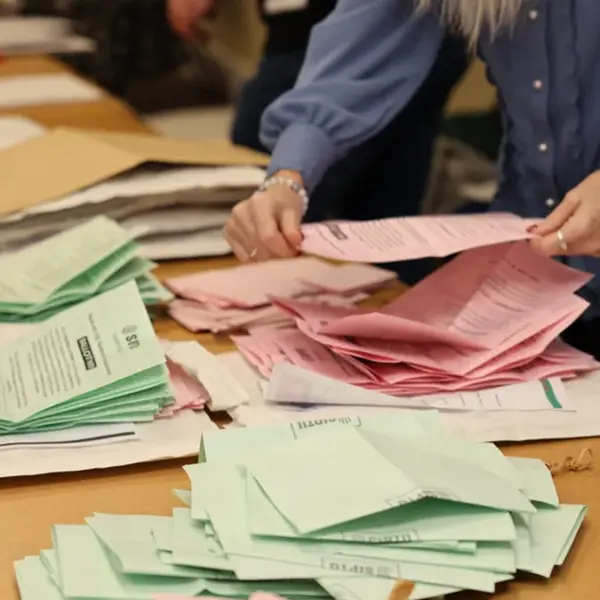
As Ballots Counted: Public Sector Worker Speaks Out
1 September 2026
SIPTU members have voted overwhelmingly for strike action. Workers saw the government make concessions to the fuel protests and government reluctance give public sector workers a much needed payrise is fuelling massive anger.
The agreement governing the pay and conditions of roughly 385,000 public sector workers expired at the end of June. Members of the nineteen unions represented on the Public Services Committee (PSC) of the Irish Congress of Trade Unions (ICTU) are being balloted on whether or not they are willing to take industrial action. This all depends on certain conditions being met to form the basis of talks with the government.
This moment presents a serious challenge to some of the accepted orthodoxies of the trade union movement, and to all trade unionists. How are we, as workers and socialist activists in the unions, supposed to interpret this moment?
What do the next few months look like for the workers taking part in the ballots and mobilising for potential industrial action? In all likelihood, success does not look like much, a much needed but small increase in wages. But failure to secure this carries the risk of leaving the trade union movement weakened.
A sober, serious assessment of the situation is necessary to not only ensure a victory for workers today, but also to ensure this moment doesn’t pass us by without building a stronger foundation within the workers movement.
For some, the recent aggressive posture by Congress may have come as a surprise. While so-called “social partnership” – bosses and union officials working together to maintain industrial peace – hasn’t been the official framework for industrial relations for many years, versions of it have prevailed in the form of national agreements going back to the financial crisis and the battering workers took in exchange for holding on to as many jobs as possible.
In recent years, the term “social dialogue” has taken over as the desired framework, which shoe-horns a revitalised interest in social democratic politics, left populism, and the watered-down demands of social movements into how the Government and trade unions engage with one another.
As far as I can tell, however, social dialogue is not an official framework codified in any policy or legislation; it is aspirational and open to interpretation. What remains from the partnership days, however, is that Government bosses and union bosses continue to show a strong preference for the negotiating table and in keeping grassroots workers from seizing control of their own unions and the entire industrial relations process.
The growing cost of living crisis saw small employers, agricultural contractors, bus companies and farmers block city streets and fuel depots. Workers looked on as the government bought this militant movement off. Then the same government says they’ve no money for public sector workers. But the message had already been sent out to the workers: militancy pays. The union leaders were forced to change direction.
It is not unreasonable to speculate that the push for this new posture comes almost entirely from the mind of Kevin Callinan, general secretary of Fórsa and chair of the PSC. But he needs more than just an idea to change the course of industrial relations in this country - he needs an army to realise any ambitions he might have. We are that army and just as our bosses have no power over us when we choose to exercise our collective strength, Callinan is powerless unless we decide to fight for ourselves.
Many across the public sector unions are woefully unprepared and unorganised. Other than a handful of cohorts that have had minor disputes or the unions that are less hesitant about going on strike, few will have any experience of industrial action. Activists and reps are now in the position of having to rapidly organise workplaces and drum up support for a ballot, all while explaining what is at stake and the decision taken by the lead negotiators of the PSC. This is no small task.
We know it is impossible to conjure up a militant, strike-ready mass of workers out of nowhere. After decades of inaction, stagnant or declining density, and operating under one of the more restrictive trade union legislative regimes in Europe, workers are now being asked if they are willing to go to the mat without knowing what the battlefield looks like or what will be asked of them.
Workers are angry but organisational deficits and the lack of a roadmap won’t see us focus that anger. And yet both Kevin Callinan and Owen Reidy, the general secretary of ICTU, believe now is the time for unions to stand up and fight back, to “flex our industrial muscle,” as Reidy put it in a recent Irish Times interview.
The two looked at the ability of a handful of small capitalists in the haulier, private transport and agri-contracting sectors to cause major disruptions and hold the government hostage. Callinan and Reidy rightly echoed the analysis of socialists to suggest that workers should be able to do something similar.
But are Reidy and Callinan serious when they say it’s time for workers to flex their muscles? I hope so. But, looking at the battlefield ahead while looking backward at the track record of our union bosses over the last number of years, and considering the current low-struggle moment, a sober assessment does not suggest that a general strike with revolutionary potential is on the cards.
In the same interview where he said the unions needed to flex their industrial muscle, Reidy talked about his family’s union history and discussions with his grandfather. He said he would “be giving out about the Labour Party being in government, saying they weren’t left-wing enough,” while his grandfather would tell him he “needed to be at the table to influence things.” Which lesson do we think he learned? What has been the dominant strategy for decades?
In all likelihood, if the ballots come back from across the PSC affiliated unions in favour of industrial action, up to and including strike action, then Callinan will go into a new phase of the chess match and cautiously take his time considering his next move in the hopes that it brings an end to the match. But they have to be cautious. The heat from members is high at the moment. But it has no organised expression. That’s to the advantage of the union tops.
We can expect at least one grand day out for everyone to rally the troops, boost morale, and show what Callinan thinks is the strength of his hand. From then on, it’s anyone’s guess how exactly industrial action might progress. There are obvious areas where maximum disruption can occur. Areas with high density, turnout and support, like hospitals, schools, a select few departments across the civil service such as the Department of Social Protection or units in the Department of Agriculture.
But it is less clear what the other couple hundred thousand workers are meant to be doing in the meantime, and how effective any slow-downs or work-to-rule orders might be for each cohort? Things can stagnate very quickly and workers might become disillusioned if the industrial action decided on for their sector makes them look weaker, rather than stronger. We can’t just strike and then beg for talks, protest at the Dáil then beg for talks, strike a little more and then beg for talks.
Does anyone even realise how many public services exist in today’s state? Given the wide variety of work that takes place in the public sector, some areas might feel real impacts from workers removing their labour in a matter of days, while others might need several weeks or months before the impacts of action are felt by management and wider society.
This could leave many workers exposed to future, isolated battles if management knows it can outlast workers who are already struggling before they need to come to the table. This can also draw out a recognition of a flawed strategy on the part of the union bureaucracy. If workers get a sense of their potential influence, only to have it stifled by a drawn out process of action undertaken in the hopes of getting certain commitments to open talks, this could help clarify a more militant perspective for workers across the unions.
If Reidy and Callinan are genuinely looking to this year’s fuel protests, then the lesson they should be learning is that flexing the muscle of the working class means all out indefinitely until our demands are met and not just until such time as the Government decides its ready to reopen talks.
Pulling the rug out from under workers on strike, who are starting to get a sense of their collective power, would be disastrous for the workers movement if all they get in return for taking the risk is the prospect of a compromised negotiated settlement that gets them less than if all 385,000 workers decided they weren’t going to clock in for as long as it took to get what we deserve.
But Reidy and Callinan know that their own positions within the union bureaucracy would be compromised if they allowed such a situation to develop. This is partly due to the highly restrictive legislation that governs union activity in Ireland and, as Reidy pointed out, to the capitalist state’s fingers on the scales in favour of the bosses.
In the IT interview, Reidy rightly said that “if one of our unions decided to block the airport, they’d be arrested in an hour, and an hour after that there’d be a letter sequestering the union’s funds from the High Court”. Fortunately for them, they would never sanction anything that jeopardises their financial assets (other than allow membership to plummet), and you can almost guarantee there won’t be a single worker involved in strategy discussions. Executive committees across the unions will take their marching orders from the bureaucrats, not the workers who voted them into positions of power.
What the union bosses know intimately, too, is that there is inevitably going to be an agreed upon framework for negotiations that limits them to compromise, to selling us out. When the Business Post mentioned in a recent article calling Callinan’s proposal of an inflation indexing mechanism for public sector workers “radical” (four other European states use this and none of them are “radical” socialist republics), they wrote that there is less than a billion to play with for the next deal.
The voice if the bosses noted this in order to keep the state in line with domestic and European Union spending rules, and the Government will have no problem presenting the false choice of funding this or funding that, pitting segments of the working class and the vunerable gainst one another. Callinan knows this.
He can, rightly, make the case that these are false choices. But will he go so far as to say Irish sovereignty is threatened by subservience to the European Union? That the structure in which we operate is one that technically and legalistically makes it impossible for a socialist party or left coalition to govern as a socialist party? When the choice is a forward march that challenges the system or a compromise deal, the union bureaucrats will always choose compromise.
Will he say he was wrong to pull us off the picket, or to only have a one day strike, when he is forced by the rules of the game to compromise? Will he suddenly say we need a revolution to put workers in the driving seat of the State and the economy? I have my doubts.
They play by the rules of the game and the game is stacked against workers. At the moment no political or social force in Ireland exists that can mobilise as many people as the unions can. But if a massive strike movement of workers brought the government to its knees the trade union bureaucracy would show itself unwilling to take such a dramatic step, because it is designed to strangle working class revolution in the cradle.
Various factions on the socialist left are jockeying to influence the situation. For instance, as part of the reformist coalition of the Affordable Ireland Campaign People Before Profit is hosting a “Workers’ Forum” at the Dáil. While there’s nothing inherently wrong with trying to give a political steer to workers engaged in struggle, if that steer is in the direction of support for the captured opposition and more talk salvation from above in the form of a left government then revolutionaries in the unions need to make their own intervention.
So, what is to be done? Revolutionary workers need to take advantage of the opportunities a heightening of tension and worker activity presents. We cannot stand apart from the broader organised workers movement, but we cannot just follow the cautious line of the union bosses either.
First things first. It is imperative that the ballots across each union produce nothing but resounding yes votes. To falter at the first hurdle would send a signal to Jack Chambers, the Minister for the Department of Public Expenditure, and the Cabinet member with ultimate responsibility for the employer’s side of any negotiations, that the unions are not to be taken seriously.
This would set the trade union movement in Ireland back years in terms of organising and strength. Three things need to happen before anything else even matters: 1) the ballots need to return a yes vote; 2) the turnout needs to be high, and 3) the margin needs to be overwhelmingly in support of industrial action. Thankfully the SIPTU ballots showed over 90% of workers want to fight.
A low yes vote sends the same message to Chambers that this is a fight he can win. This means pay will continue to stagnate or get eviscerated by inflation, changes to working conditions such as hybrid/remote working, the use of productivity technology, surveillance, and the million-papercuts-strategy that has been ongoing for years will continue with no viable force to prevent it from doing serious damage to the lives of workers across the country.
When the ballots come back in favour of industrial action, and the margins are there, then what happens next is anyone’s guess. As I covered above, it might be a total mess, staggered actions and token protests, but the opportunities for revolutionaries within our unions are in that mess. We have to push for united all-out action and be seen to be the ones pushing for it.
For those workers who will be on the front lines in the essential sectors, revolutionaries need to fight like hell to support them and worker leaders need to find ways to use even partial actions to coordinate and build worker autonomy and militant capacity. If you are a shop steward or workplace rep, now (not in a couple of months) this is your chance to have a massive boost in membership in service of the ballot, but also to improve the chances of industrial action working down the line.
This is your chance to establish worker committees in each workplace. If your union branch committee is rotten with line-towing reformists who just like to raid the dues to pay for expensive dinners or trips to union conferences, then set up a way of coordinating among yourselves.
Set up your strike committee now and get people talking about the kinds of industrial action you can take in your workplace. Know who is responsible for keeping discipline in every area of every office, and they know who to call for support if management puts pressure on anyone participating in lawful union activity. Find ways to write to executive committees and publicise a radical strategy. Find the grassroots reform caucus in your union and start publishing a radical line in your own propaganda. If there is no grassroots reform caucus in your union, start one.
Let’s face it, the number of people in our unions with a revolutionary perspective probably amounts to no more than a few dozen. But there are many more good trade unionists among us, and their organising abilities and experience will be essential in the fight. But this cohort does not have the strength of influence to turn the workers’ movement into a revolutionary movement on its own, nor should it sell a fantasy to workers. We are in a period of preparation and have to use any action to advance that perspective and our organisational capacity.
The potential of the coming moment will ebb and flow with each minor development. From the ballot, to the first grand day out, to the targetted industrial actions, the landscape will change. The union bosses will always try to steer it back to the negotiating table. While material circumstances can change and people can respond in surprising ways, it is unlikely any force on the socialist left can sway enough people to stop the majority from coalescing around a position of compromise when the union leaders call a halt to the movement.
But what the revolutionary workers can do in this movement is strengthen their numbers, build around them and sharpen their analysis. Prepare to address a larger audience of angry workers who will be frustrated and infuriated when the movement falters.
If you try and sell an ordinary worker on a fantasy now, and Callinan brings back a shit deal, you’ll have lost that worker for good. If you can explain why it is necessary to not only vote yes for industrial action, but to fight like hell to make sure you win, and can with some accuracy forecast the strategic liability of the union bureaucrats, then you’ll have gained the trust of a potential comrade.
This brings me to my final point: don’t lie. We need to fight to get the best for workers today without compromising our revolutionary politics. Do not overpromise or let anyone believe anything will be handed to us if we just follow what the union negotiators say. Remember that anything that is won can always be taken away and the next pay agreement, if there is one, is unlikely to last beyond 2027 (especially if we win an inflation indexing mechanism).
Fighting today, boosting union membership, winning some concessions, does not mean victory. The fight carries on until workers control the unions and can fight for control of the state. Victory means fighting and winning today in preparation for the next battle and the next and on in the direction of a 32 county socialist republic, not another compromise deal with politicians who would do anything to undermine our struggle to put the workers in the driving seat of the economy and the state.
Join your union and join the Reds if you agree!
 RED NETWORK