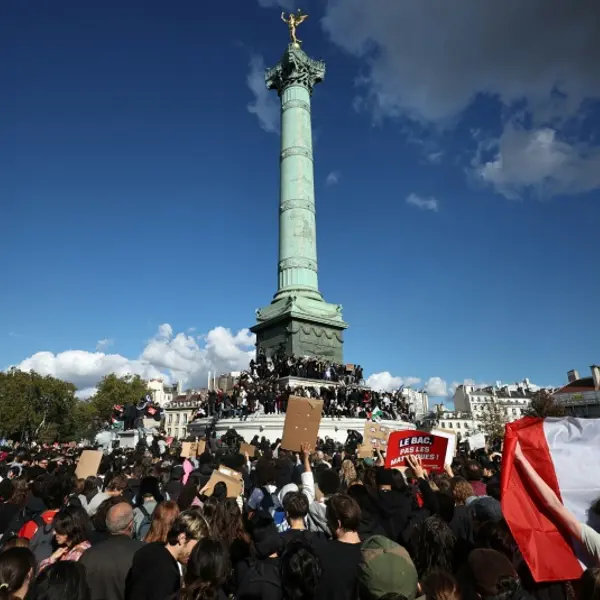
French Students Challenge The State
10 October 2026
As images of children mangled by the French state spread, as mass protests rivalling the numbers of the famous Yellow Vest movement spread throughout the nation and as arrest numbers surpass 5,000 with over 80% of those arrested being children - the French establishment asks itself one question, what the hell is happening here?
There were no warnings to indicate a protest movement of this size was going to take off. No union, NGO, civil rights organization or political party called for the initial action. Word simply spread after students in Créteil (a suburb of Paris largely inhabited by working-class minorities) staged a demonstration against the lack of resources for their high school, and other impoverished suburban schools decided to follow suit.
Blockades were set up at dozens of schools, fires were started at some of the schools and the police rushed in to bring the students “back to their better senses”.
The police, adopting what the Minister for Justice called a “firm but measured response”, fell back on reliable measures. Batons, tear gas and stun grenades rained down on the children protesting. Videos started to go around on social media showing everyone what the police considered to be “proportionate”; secondary students with their hands blown off and a police officer attempting to drown a 15 year old for daring to fight back when the cops came down on their demonstration.
With the memory of the police murder of 17 year old Nahel Merzouk fresh in the minds of minority youth, they were determined to draw a line in the sand. The protests took on a distinctly anti-police and anti-establishment tone, the demonstrators started fighting back against police repression where they could, and the movement grew.
By the time political parties and unions came out in support of the movement, they were only recognising an established reality that had taken hold of the nation. The crowds had already mobilized, the only choice anyone had was to get in or get out of the way.
Something striking about this protest, which has caused both fear and confusion for the capitalist politicians and press, is the wide ranging demands that the movement has raised. While anti-police and school funding demands have been portrayed as the primary themes of the movement by the press, at any of the protests you’re equally likely to see signs decrying the government’s recent militarization efforts, lamenting the rise of the far-right Rassemblement National party, or completely rejecting the legitimacy of the Macron regime.
The government has used this to paint the protestors as “unreasonable”, even blaming the reformist left party La France Insoumise for somehow controlling and radicalizing the movement behind the scenes. The truth, however, is more accurately summed up in a slogan seen at various protests, “the youth want a future”.
The students who started this movement, coming from impoverished areas hit hard by the government’s turn to austerity, are living through a time where wildfires burn up half the continent, far-right movements tell them they’re ‘incompatible with the national culture’ and a global pandemic forced them into their homes for over a year.
Fears about AI raise questions about whether they’ll even be able to get a job out of school. The immediate issue at hand might have been funding in schools, but the mood behind the movement is much simpler - anger. Anger at a state that has abandoned them in the past, anger at a state that has abandoned them in the present, and anger at a state that has abandoned their futures.
However, as activists on the scene have relayed, in the recent demonstrations there appears to be two movements happening at the same time. The first comes from the grassroots, from the suburbs in which the movement originated, ready to take on the police and use whatever momentum they have to strike at an establishment that is prepared to leave them behind.
The other one forms a much more uncertain element, largely coming from the groups that rushed to the front of the barricades after they had been established. La France Insoumise forms the main political element of this secondary movement, sympathising with the students who pushed the establishment to its knees, but simplifying their demands and reframing the students’ actions as “self defence”.
The truth, however, is that for once working class youth are on the attack, and any who flinch at the sight of this reveal themselves to be disconnected from the anger which has arisen from decades of neglect and austerity. The union bureaucracy for its part proved itself just as cowardly in France as it is in Ireland.
The Alliance Syndicale (the French version of ICTU) is seemingly ignoring the call for national action on October 17th and instead calling their own demonstration on November 5th. They surely hope that things will have calmed down by then. However, some workers in the grassroots and lower levels of the unions have shown their so-called ‘leaders’ where they stand, with dockerworkers in Marseilles and trade unionists in Bordeaux fighting off the cops to protect student demonstrators.
Révolution Permanente, a French communist group that has been remarkably active over the course of the movement, declared that the unions had already betrayed the movement. They used this analysis to justify shifting their efforts towards unifying the high school demonstrators with university students, a strategically sound move for Révolution Permanente considering they have far more of a base of support with students.
But what Révolution Permanente can’t seem to see is that by abandoning the unions you abandon the grassroots workers pushing for unity with the demonstrators. This only leaves the movement weaker, as the workers are left isolated in their struggle against the would-be compromisers in their leadership.
The farmers’ protests here in Ireland proved that a ‘popular’ protest movement without worker participation has clear limits, as workers are the only groups with their hands on the economic machinery that keeps society running.
In order to push these struggles forward communists need to be serious about our support of grassroots workers when they ask for more than their moderate leadership is offering. The unity of working class trade unionists and the students from working class areas that started this movement is essential to its success, as the working class is the only force which truly has nothing to gain from the current system and can thus strike at it most effectively.
Student protests can act as an inspiration to workers but they cannot take on the state by themselves. These movements can explode onto the scene but then fall back as quickly as they rose. You have a short window of opportunity to connect with and inspire workers to fight as it is the working class that can actually deliver a future for the fighting students.
We stand with the students and workers currently on the barricades and recall the words of James Connolly who said: “All hail, then, to the mob, the incarnation of progress!”.
 RED NETWORK