Workers Strike Back From Ireland To Italy!
26 October 2026
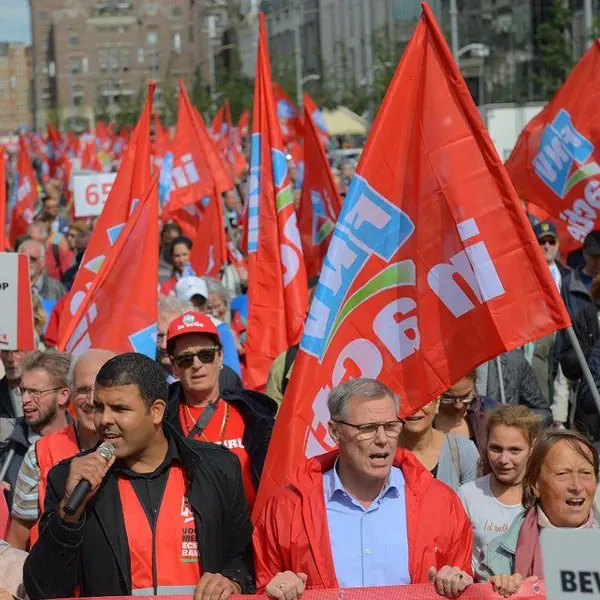
The working class across Europe has had enough. There are strikes and protests planned in many European countries as the cost of living crisis bites harder. Here in Ireland recent polling showed 57% of people wanted further strike action over public sector pay.
In France a wave of student protests were joined by former Yellow Vest activists and workers’ trade unions. Over 800,000 marched last weekend across the country. France hasn’t managed to balance a budget in decades. While French workers are militant (and in return get a high level of public services) the establishment refuses to pay for this by taxing the rich, the result is a completely bankrupt state.
The mainstream media made a big deal about riots following French protests but failed to report the growing role played by French workers. There is a major national strike planned for November 5th which will see workers all over France down tools.
The strike is supported by an inter-union alliance made up of five of France’s main union federations. The strike will include railway workers, dock workers, airport workers and public sector workers too.
The workers’ movement will also be supported by student unions who are still protesting the neglect of French schools while the wider protest movement escalates to challenge the French government’s austerity budget of €44 to €54 billion in cuts.
It’s much harder for riot cops to target workers’ picket lines and get into workplaces and the power of the working class is key to the victory of the protest movement. It is workers who can shut down the economy and hit the French bosses and their political puppets in the pockets.
In Spain workers have joined the growing housing protest movement which began after a pensioner was cruelly evicted from her home. She later died. Squares in major cities have been occupied by housing activists while workers have called a housing related general strike for November 11th.
Two major unions, covering 70% of Spain’s union representation, have called the strike with support from local workers’ councils and unions in the Basque region. They can’t legally call a strike over housing so they have connected wages and housing framing: “housing and wages as the same struggle!” That way they can get around anti-union laws.
The intensifying class struggle has forced the centre left Socialist Party government (like the Labour Party here) to call an election for November 29th. Housing activists in Portugal also set up tents in squares but were attacked by riot police. This led to massive protests and a call for a national strike that unions want to coordinate with the massive strike happening in Spain.
In the Netherlands a major strike wave by workers forced a major retreat by the government who have dropped a €6 billion package of budget cuts. A wave of strike actions by workers escalated into a general strike on September 9th 2026. This broke the government and the austerity budget was withdrawn.
A wave of rolling 24-hour strikes by railway workers hit the government on Wednesday October 14th. This was to be followed by a second wave of strikes on Thursday October 22nd. The second strike was called off at the last minute to go into talks.
The moment the wider workers’ movement left a gap open the far right mobilised with massive anti-migrant riots at the end of September. Most people supported the workers’ strike actions and it’s up to workers to focus all the anger in Dutch society against the establishment. When workers move it can act to provide shape and leadership to wider discontent, rather than allowing attack dogs of the establishment to save the system through misdirection.
Italian workers are preparing for a national strike on Friday November 20th. The strike will see the main transport, healthcare and public sector unions mobilizing against Prime Minister Giorgia Meloni’s upcoming state budget.
The hard right government is on the attack against the working class, an attack that has already triggered massive railway strikes. Inflation has hit 4.2% in Italy and while workers are feeling the pinch the government has launched a series of attacks. On October 17th and 18th “no Meloni day” day saw tens of thousands of workers and students protest.
The biggest union federation, the CGIL, called a national strike for November 20th. Meloni has put troops on the streets to try to intimidate workers and student protests. But the national strike can really force the government to retreat as workers in all sectors down tools as one.
Following mass worker protests and public sector shutdowns earlier in October, Belgium’s trade union federations have joined forces to organize a massive national protest in Brussels. Unions have warned that this protest will serve as the launchpad for a general strike.
An incoming right wing government, arguing for massive spending cuts, triggered the protests. The day after the massive national protest there will be a rail and transport strike, followed the next day by a national strike of all public sector workers.
A massive wave of protests and strikes has erupted in Greece too. The primary teachers’ union federation had a 24-hour general strike, while secondary school teachers had a shutdown to protest 15,000 vacant teaching positions and unsafe, overcrowded schools. Doctors then staged a national walkout followed by public sector workers.
There will be a port strike on October 30th which is against Greek ports being used for war. Workers across Greece are building towards a multi-union national strike on November 25th that will challenge the right wing government on wages, austerity and funding for public services.
German car workers have been holding major protests against Volkswagen’s plans to close plants. Anti-union restrictions limit legal strike until January when pay deals run out. Militants have been calling for wildcat strikes to take place before then.
A student movement called “Gen Z’s Got It!” has called protests across Germany while there are ongoing protests against conscription. General strikes are illegal in Germany so there are no plans for coordinated action between workers’ unions and the youth movement. Solidarity with the car strikes offer a chance to put workers at the heart of defying the German bosses and their state.
Major protests and strikes have broken out in Serbia and Albania too.
While the cost of living crisis escalates, governments across Europe have allowed the market to take over housing provision, leading to a massive housing crisis across the continent. While real wages fall back, governments prioritise military budgets and corporate welfare.
Here in Ireland the Fianna Fáil, Fine Gael, Lowry government have been able to use a large budget surplus and compliant union leaders to defend themselves. But the militancy and scale of the October 14th public sector strike showed the potential for mass workers’ struggle here in Ireland too.
The fuel protests and the concessions made by the government embarrassed union leaders, forcing them to posture as radical. But as soon as they got a chance they cancelled the second day of strike action without any offer on the table. Talks are still going on.
But workers in Ireland are angry and even the Sunday Business Post, voice of the Irish bosses, voiced their concern, writing: “Ireland is one major economic blow away from the kind of populist upheaval that has been seen across much of the world in recent years.”
The trigger for these varying European protest and strike movements may vary but the underlying weakness of 21st century capitalism and the legacy of decades of neoliberal outsourcing and privatisation underpin them.
The pendulum of struggle shifted massively to the left in the years following the bank bailouts of 2008. Those movements were led by those who failed to challenge the system and the initiative was given over to the right. From 2016 to 2026 the pendulum swung to the right in many countries as workers were demoralised and struggle fell back.
Now the working class is awakening and the potential exists for a new wave of working class struggle. Every cycle begins covered in the mud and dirt, the legacies of the previous swings. It’s our job to prepare our class, to oust leaders who won’t carry the fight through to the end and to finally put workers in the driving seat of our unions so we can fight to put workers in the driving seat of worker-run economies.
It’s going to take hard work to build up a layer of worker militants who can challenge the current bureaucrats who lead out unions. But we aren’t afraid of hard work. That’s the only way out of an endless cycle of capitalist crisis. If you want to roll your sleeves up and prepare for a rebellion of our class, join the Reds.
 RED NETWORK