What Do We Mean By Revolution?
7 November 2025
When you say Ireland needs a revolution people often don’t understand exactly what you mean. It conjures up images of a small group of people storming the GPO and hoping for the best. But a working class revolution is about a massive show of people power because the path to a new society is in part shaped by how you get there.
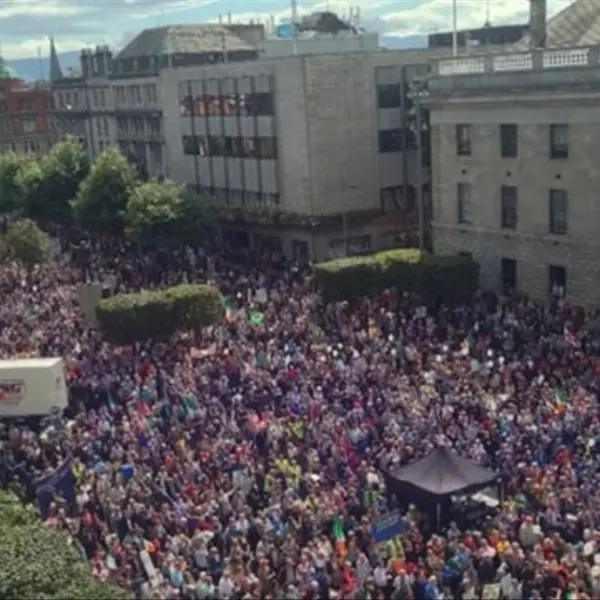
Imagine the water charges movement but even bigger and more sustained. Now imagine that accompanied by mass strikes by workers, shutting down the flow of profit to the greedy bosses. A strike that covered the whole country would have to be coordinated, that would mean forming committees to organise that coordinated action.
In past revolutions like in Russia in 1905 and 1917 or in Chile in 1973 workers formed their own democratic mass assemblies, they were called “Soviets” in Russia and “Cordones” in Chile. They democratically coordinated the working class fightback.
Moderate and middle class socialists saw these assemblies merely as a way to fight but not as the embryo of a new workers’ state that was emerging from below. Revolutionary groups like the Russian Bolsheviks argued for “All Power To The Soviets!” encouraging workers to keep fighting until all the bosses and landlords were kicked out of power.
The bosses have economic and political power. If you just occupy the workplaces but leave the state intact they’ll come evict you. If you challenge state power without the backing of strikes in workplaces you are weakened and you don’t create the embryo of a new alternative state power.
A severe economic or political crisis can provoke massive shows of people power - as we saw after the bank bailouts in 2008, but the system can rely on their state machine to use two key methods of control to stop a revolution, they’ll use the carrot and the stick.
They can call new elections to try divert people from the streets and workplaces to the debate in parliament and when this fails they use force, sending the Guards in to evict workers who are occupying a workplace, or to confront protesters.
We saw the state in action during the Debenhams strike where they sent the riot squad in to remove workers who were just asking for their redundancy payments. Or just look at the campaign of slander they directed against a moderate challenge to their power when Catherine Connolly won the Presidency.
The Indignados movement in Spain saw tens of thousands occupy squares across the country but when the ruling class called elections the street movement, which had no clear political wing, was disoriented.
While having no party of their own can disarm workers, so can having the wrong type of party representing workers. In the final year of the 1960s there was a million and a half strike days lost as workers fought back with flying pickets and militant strikes.
Labour benefited from this explosion of militancy and they used this support to guide the movement back into safe channels, they went into coalition with Fine Gael in 1973 and demoralised the workers preparing the ground for the return of Fianna Fáil in 1977.
Often concessions are made with the clear intention of disarming the movement and then when the level of militancy falls back they move against those who are still fighting.
In the case of the Russian Revolution of 1905 the ruthless Tsarist regime offered a parliament to calm the workers - the liberals and moderate socialists jumped for this carrot, at the same time the Tsar had his secret police organised pogroms, a campaign of mass murder, against Jewish workers and the left.
In Greece the radical left party Syriza formed a government and then backtracked on all their promises when threatened by the EU and the Greek rich. This demoralised workers and led to a collapse in the level of protest.
We saw the same thing in miniature here in Ireland when the water charges movement challenged Fianna Fáil and Fine Gael and they offered Marriage Equality and Repeal to seem like they were making concessions to progress. They were just trying to shore up their voter base to keep the show on the road.
So workers need the type of party, a party made up of class conscious workers. Why do you need such a party if workers have mass assemblies? A “Soviet” or workers’ council is a vehicle that mobilises all workers who want to fight. It is like a campaign, like the water charges, where all groups come together to fight.
That’s its strength and its weakness. There will be groups inside the assemblies trying to sabotage the revolution. Their supporters have to be involved in the struggle as this will open their eyes to their leaders. But their leaders will still try to divert the movement.
And who makes the call for mass assemblies? It would have to come from workers who were revolutionary and prepared for that moment. Otherwise the movement would remain in the hands of the traditional union bureaucracies and they’d try suffocate any militancy on sight.
That’s why those workers who’ve been preparing for a revolution and know that workers need to take power to win need to be organised and be able to pull in the same direction. That includes having a presence in the Dáil where you can use that platform to rally workers to the revolution and point out ruling class tricks.
A general strike would see workers have to coordinate on a national level. They’d have to decide which food deliveries should go ahead or where power should be on. They’d already be a potential government in waiting.
That’s why revolutionary situations are often called a “dual power” situation - the old state machine - the police, army command and bureaucrats - is still sitting there wrestling for power with a new potential state, emerging from struggle.
If the worker assemblies dismiss the old Dáil, Senate, cops and army command and replace them with the worker assemblies, that’s a real revolution. Workers would then elect a worker’s parliament where reps were on the average workers’ wage and recallable.
Industry specific assemblies could then democratically coordinate with these workers’ parliament to plan industry by industry bringing key areas like housing or healthcare under democratic control.
People might think a general strike is far fetched but that’s because we’re so used to partial fights being isolated and beaten. The Irish Ferries dispute saw 100,000 workers march and the anger among workers was so strong the union leaders were forced to call actions.
If there were bread riots because the economy had collapsed worker actions could break out right across the country, but they’d need to be initiated and encouraged by workers who were already embedded, respected and ready for a fight.
Revolutions break out when the ruling class is in crisis and fighting amongst themselves and the working class feel there’s no other way out except to challenge the system. If the workers rise but the ruling class are united they can crush the working class.
If ruling class are split but the workers feel there are easy options they’ll fall for the carrots offered by the establishment. You need a crisis and for workers to feel they’ve exhausted all other options.
The funny thing is by fighting like a revolutionary, with an eye to the overthrow of the system, you win more reforms! Yet if you start out the fight with a view to compromise with the system they get the measure of you and offer less. Workers who fight get more than those who compromise.
That should inform our attitude to talk of a left government. If Sinn Féin formed a government with Labour, the Greens and the Soc Dems that would be a pro-capitalist government resting on the same old corrupt state machine.
We’d welcome the defeat of Fianna Fáil and Fine Gael but the system would use Sinn Féin to demoralise and defeat the working class. Sinn Féin are far less radical than Syriza in Greece and Syriza proved easy for the ruling class to tame.
That’s why we’ve always said that any future Red TD would not join any capitalist government but instead would support a left government externally and case by case. The job of working class socialists is to represent the working class no matter what. That means being free to tell the truth and being in the strongest possible position to rally workers to fight.
Our job is to build for a revolution. We have no choice. Revolutionary situations are coming in the future. The Irish economy is an unstable tax haven, a house of cards ready to fall over. And workers will pay the price when it does.
The question isn’t do you want a revolution or not?
The question is - if the revolution is coming how can we prepare to win? We have a chance to start our preparations now by building up grassroots groups in all the major unions, by building a new fighting worker led left and by being honest about the hard work ahead to be ready.
Imagine an Ireland run by assemblies of workers, a health service run by nurses and doctors themselves, a building industry run by workers who know how to build homes, the mass assembly model is the best way to fight, the best way to establish dual power and the best way to establish a real democracy.
That’s what we mean by revolution.
 RED NETWORK