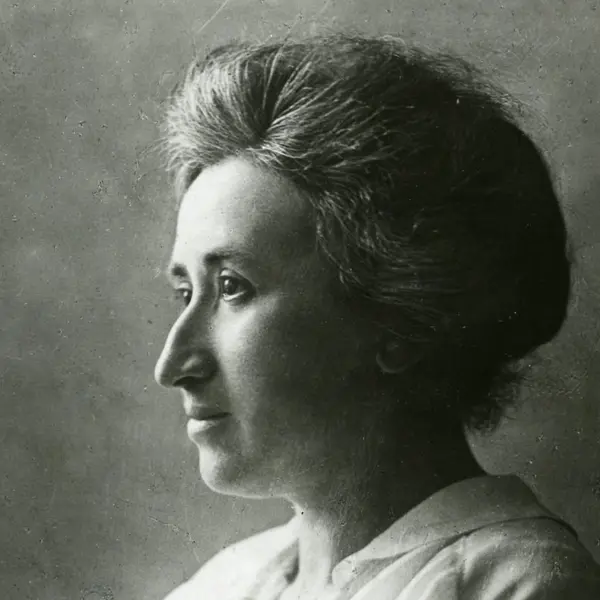
Rosa Luxemburg, Ministerial Socialism And Left Government
20 August 2026
At the turn of the 19th century the workers movement was still in its infancy. Industry was rapidly developing across Europe and with it the working class, or the proletariat. Workers began organizing in trade unions and in the early socialist political parties. As the parties grew with membership in their millions numerous tendencies began to form within them. Middle class intellectuals were also joining the socialist parties and often took on leadership positions within the parties and the trade unions.
The German Social Democratic Party was founded in 1875 and by the early 1900’s its membership had grown to about a million members. The party also stood in elections and by 1903 they were getting 32% of the vote. This made the German SPD the largest socialist party in the world at the time. It also meant that the party had a large apparatus with elected representatives at every level of government and a party bureaucracy of employed staff.
The Polish socialist Rosa Luxemburg moved to Berlin in 1898 from Zurich where she had studied economics at the university. She had already gained experience in socialist organising and theory in her native Poland before going to Zurich. In Berlin she immediately began an ideological battle with the party leadership, in defence of revolutionary socialism against what was then called revisionism, what we today would call reformism. The main theoretician of this tendency was Eduard Bernstein who wrote his book The Preconditions of Socialism and the Tasks of Social Democracy in 1899.
Bernstein’s argument was that capitalism had entered a new phase of development, one without the recurring economic crises that Marx had predicted. Because of this, Bernstein argued, socialism was now possible through incremental steps and without the revolutionary overthrow of the capitalist state. Rosa Luxemburg, despite being fairly new to the party, became the main theoretical opponent of Bernstein within the SPD.
She took on the argument with gusto. In her essential pamphlet Social Reform or Revolution from 1900 she broke down Bernstein’s argument and countered it with the full force of a revolutionary.
She argued that Bernstein’s views were the equivalent of giving up socialism altogether. She said that: “Bernstein himself has very clearly and characteristically formulated this viewpoint when he wrote: “The Final goal, no matter what it is, is nothing; the movement is everything.” But since the final goal of socialism constitutes the only decisive factor distinguishing the Social-Democratic movement from bourgeois democracy and from bourgeois radicalism, the only factor transforming the entire labour movement from a vain effort to repair the capitalist order into a class struggle against this order, for the suppression of this order – the question: “Reform or Revolution?” as it is posed by Bernstein, equals for the Social-Democracy the question: “To be or not to be?” In the controversy with Bernstein and his followers, everybody in the Party ought to understand clearly it is not a question of this or that method of struggle, or the use of this or that set of tactics, but of the very existence of the Social-Democratic movement.”
She argued that Bernstein’s ideas were not merely a “revision” of Marx’s ideas of socialist change but a complete surrender of socialism, in favour of a slightly better capitalism. She continued: “Today he who wants to pass as a socialist, and at the same time declare war on Marxian doctrine, the most stupendous product of the human mind in the century, must begin with involuntary esteem for Marx. He must begin by acknowledging himself to be his disciple, by seeking in Marx’s own teachings the points of support for an attack on the latter, while he represents this attack as a further development of Marxian doctrine. On this account, we must, unconcerned by its outer forms, pick out the sheathed kernel of Bernstein’s theory.” She meant that Bernstein, just like so many other reformists after him, still called himself a Marxist and for that reason she had to go through his arguments in detail to prove the fact that he had actually abandoned Marxism.
She saw the class nature of Bernstein’s ideas and was clear that “The opportunist theory in the Party, the theory formulated by Bernstein, is nothing else than an unconscious attempt to assure predominance to the petty-bourgeois elements that have entered our Party, to change the policy and aims of our Party in their direction.” She understood that the middle class (petty bourgeois) layers of the party bureaucracy was turning the party away from working class revolutionary socialism towards liberalism. Luxemburg argued that this was not a conscious but rather an “unconscious attempt”. That if Bernstein and his followers were conscious of their abandoning of socialism they would simply have left and joined the bourgeois liberals but it was precisely the fact that they were within the workers movement that she needed to take this argument on. This is something we see time and time again, the unconscious attempts to disorganise and confuse the workers movement from within, by middle class elements. Even in parties that call themselves marxists or revolutionary we see this trend constantly reemerging.
Luxemburg understood the need to take on Bernstein’s argument not just by declaring it to be a deviation from Marx but also by breaking down each theoretical argument made by Bernstein at a time. He gave his argument an economic basis, that capitalism at that particular stage had stabilised, that it was no longer crisis prone. Marx had argued that capitalism would enter into crisis every ten years or so, and when there was a longer period without a crisis Bernstein used that to argue that Marx had been wrong. He then attempted to explain why this was the case and came up with the idea that there were mitigating factors against recurring cyclical economic crises. This argument quickly became obsolete when an economic crisis hit in 1907-08. In Rosa Luxemburg’s revised version of the pamphlet from 1908 she said: “Crises may repeat themselves every five or ten years, or even every eight or twenty years. But what proves best the falseness of Bernstein’s theory is that it is in the countries having the greatest development of the famous “means of adaptation” – credit, perfected communications and trusts – that the last crisis (1907-1908) was most violent.”
In addition to his economic arguments about crises, Bernstein said that with the growth of the trade union movement it was now possible to get social reforms without the need for a revolution. Luxemburg, on the other hand, said that “Trade unions cannot suppress the law of wages. Under the most favourable circumstances, the best they can do is to impose on capitalist exploitation the “normal” limit of the moment. They have not, however, the power to suppress exploitation itself, not even gradually.” What she was saying is that workers need to be organised in trade unions in order to get the highest wages possible from the capitalists. But the trade union struggle doesn’t challenge the fundamental relationship between worker and capitalist which is the exploitation of the workers in the form of surplus value. It’s not possible for workers involved in a purely trade union struggle to change that relationship, only when workers are in control of the means of production does the exploitation of the workers end. Trade unions help workers get as much as possible of the surplus value from the capitalist but it’s in the very nature of the system that the capitalist must get some surplus value in order to reinvest and avoid going bust. Capitalists don’t operate their business for any other reason than to make profit, although they quite often publicly claim otherwise. They will never accept losing all their profits, and when they have been threatened with this they have fought back against the trade unions through all the means they have, including lockouts, relocation and breaking of unions. For this reason there is a limit to how much trade unions can win on behalf of the working class. They can never give workers the full share of the pie, nor can they challenge the fundamental nature of the system.
Next Bernstein argued that the party, through parliamentary power, can introduce social legislative reforms that will further limit the capitalists. Luxemburg explained how “He expects that social reforms, like trade union organisations, will “dictate to the capitalists the only conditions under which they will be able to employ labour power.” Seeing reform in this light, Bernstein calls labour legislation a piece of “social control,” and as such, a piece of socialism.” Luxemburg, on the other hand, argued that this is not a social control by the working class. She said: “We know that the present State is not “society” representing the “rising working class.” It is itself the representative of capitalist society. It is a class state. Therefore its reform measures are not an application of “social control,” that is, the control of society working freely in its own labour process. They are forms of control applied by the class organisation of Capital to the production of Capital. The so-called social reforms are enacted in the interests of Capital.” She understood clearly the nature of the state and that it will never work in the interest of the working class. She sarcastically commented that: “When Bernstein asks if there is more or less of socialism in a labour protective law, we can assure him that, in the best of labour protective laws, there is no more “socialism” than in a municipal ordinance regulating the cleaning of streets or the lighting of street lamps.”
Luxemburg then continued to discuss the state under capitalism, its role and its functions. She said: “The present State is, first of all, an organisation of the ruling class. It assumes functions favouring social developments specifically because, and in the measure that, these interests and social developments coincide, in a general fashion, with the interests of the dominant class.”… “When capitalist development has reached a certain level, the interests of the bourgeoisie, as a class, and the needs of economic progress begin to clash even in the capitalist sense. We believe that this phase has already begun. It shows itself in two extremely important phenomena of contemporary social life: on the one hand, the policy of tariff barriers, and on the other, militarism.” Luxemburg was arguing that because of the nature of the capitalist system and the state as an instrument of the capitalist class there are contradictions within that class that lead to instability and crisis. The capitalist class are like a hostile band of brothers. They will cooperate in order to exploit workers, but they are also always in competition with one another. This competition often takes a national form and in each nation capitalists use their own state to defend their interests on the world market. As Luxemburg pointed out this leads to both trade wars and militarism.
She continued to argue against Bernstein in terms of the role of parliamentary democracy as a mitigating factor against capitalist crises. Bernstein argued that with democracy and parliament it was possible, for the first time, for a party of the working class to gain power through democratic means. Luxemburg refuted this and said: “Now, the democratic forms of political life are without a question a phenomenon expressing clearly the evolution of the State in society. They constitute, to that extent, a move toward a socialist transformation. But the conflict within the capitalist State, described above, manifests itself even more emphatically in modern parliamentarism. Indeed, in accordance with its form, parliamentarism serves to express, within the organisation of the State, the interests of the whole society. But what parliamentarism expresses here is capitalist society, that is to say, a society in which capitalist interests predominate.” She was arguing that it is true that parliamentary democracy opens the doors to the possibility of a socialist society but that parliamentarism, and the state, under capitalism can’t reflect any other interests than that of the capitalist class. She slammed Bernstein’s gradual transformation to socialism and said: “Fourier’s scheme of changing, by means of a system of phalansteries, the water of all the seas into tasty lemonade was surely a fantastic idea. But Bernstein, proposing to change the sea of capitalist bitterness into a sea of socialist sweetness, by progressively pouring into it bottles of social reformist lemonade, presents an idea that is merely more insipid but no less fantastic.”
She argued that legislative change will never do away with the fundamental rule of capitalism, the exploitation of workers by the bosses. She said “In our juridical system there is not a single legal formula for the class domination of today… No law obliges the proletariat to submit itself to the yoke of capitalism. Poverty, the lack of means of production, obliges the proletariat to submit itself to the yoke of capitalism. And no law in the world can give to the proletariat the means of production while it remains in the framework of bourgeois society, for not laws but economic development have torn the means of production from the producers’ possession.” She was arguing that there is no law that forces workers into the exploitative relation with capital and so no law can stop this happening. Workers will continue to be forced to work under hard conditions for little pay as long as the capitalist mode of production exists. As long as the bosses own the means of production, the factories and the raw materials, the working class has no choice.
Luxemburg echoed the same views that Lenin had and which he expressed in his pamphlet The renegade Kautsky: “If we are not to mock at common sense and history, it is obvious that we cannot speak of “pure democracy” as long as different classes exist; we can only speak of class democracy. (Let us say in parenthesis that “pure democracy” is not only an ignorant phrase, revealing a lack of understanding both of the class struggle and of the nature of the state, but also a thrice-empty phrase, since in communist society democracy will wither away in the process of changing and becoming a habit, but will never be “pure” democracy.) “Pure democracy” is the mendacious phrase of a liberal who wants to fool the workers.“ In the same way that Bernstein refused to discuss the nature of the state as a class state, the centrist Kautsky did the exact same thing when he criticised the Bolshevik revolution in 1918. As Lenin said, anyone who claims that it’s possible to have socialism through “pure democracy” wants to “fool the workers”.
Luxemburg said that this was not just a question of theory, but that it had consequences for their actions. She said that the revisionist ideas of Bernstein would inevitably bring changes to the party and its activities. She said: “At present, the trade union struggle and parliamentary practice are considered to be the means of guiding and educating the proletariat in preparation for the task of taking over power. From the revisionist standpoint, this conquest of power is at the same time impossible or useless. And therefore, trade union and parliamentary activity are to be carried on by the party only for their immediate results, that is, for the purpose of bettering the present situation of the workers, for the gradual reduction of capitalist exploitation, for the extension of social control.” She was defending the use of both trade union struggles and parliament as a means to guide and educate workers, but not as an end in itself.
She continued: “Viewing the situation from the current standpoint of our party, we say that as a result of its trade union and parliamentary struggles, the proletariat becomes convinced, of the impossibility of accomplishing a fundamental social change through such activity and arrives at the understanding that the conquest of power is unavoidable. Bernstein’s theory, however, begins by declaring that this conquest is impossible. It concludes by affirming that socialism can only be introduced as a result of the trade-union struggle and parliamentary activity. For as seen by Bernstein, trade union and parliamentary action has a socialist character because it exercises a progressively socialising influence on capitalist economy.”
She pointed out the organisational consequence of this: “As soon as “immediate results” become the principal aim of our activity, the clear-cut, irreconcilable point of view, which has meaning only in so far as it proposes to win power, will be found more and more inconvenient. The direct consequence of this will be the adoption by the party of a “policy of compensation,” a policy of political trading, and an attitude of diffident, diplomatic conciliation. But this attitude cannot be continued for a long time. Since the social reforms can only offer an empty promise, the logical consequence of such a program must necessarily be disillusionment.“
This is a really important argument which has been borne out by history. Luxemburg was saying that as soon as Bernstein argued that the seizing of power by the working class through revolutionary means was impossible and that the parliamentary and trade union struggles for reform were in and of themselves socialist this changed the nature of the party itself. The party then adopted what she called a “policy of compensation” and “political trading” and that the necessary consequence was “disillusionment”. How accurately she described what eventually happened to all the social democratic reformist parties. Just look at the Irish Labour Party and how their politics of “diplomatic conciliation” with the capitalist class has betrayed Irish workers time and time again. This betrayal is not an accident.
Once socialists give up on worker’s power and revolution there is only one route that they can go. They must inevitably renege on their promises in order to keep the capitalist system running. The “empty promise” made by the Labour Party of “Gilmore’s Way or Frankfurt’s Way” during the 2011 general election led to the complete capitulation to EU and IMF imposed austerity. Comparing Bernstein to the Irish Labour Party is a real insult- to Bernstein. Because the Irish Labour Party clearly don’t consider themselves Marxists, and don’t claim to either. The more appropriate example is probably Syriza in Greece. Here you had a party that actually considered themselves marxists, although with the same politics as Bernstein. They also made an empty promise to resist austerity and stand up to the EU, but again capitulated at the first hurdle. Luxemburg’s comments on making “immediate results” a priority is also something that can be seen in organisations and individuals that claim to be revolutionary. One example of this is People Before Profit, which has become increasingly focused on putting forward legislation in the Dail or Stormont, not with the aim of it being rejected and to teach the masses about the need for revolution, but to win real gains.
Luxemburg, on the other hand, defended the methods of marxism, that is to use the parliamentary and trade union struggles until, as she put it “the proletariat becomes convinced, of the impossibility of accomplishing a fundamental social change through such activity and arrives at the understanding that the conquest of power is unavoidable.” Luxemburg’s mistake though was that she underplayed the need for the active education of the mass of workers by the vanguard in order for them to “become convinced” as she put it.
After Rosa Luxemburg had dealt with all the theoretical specifics which Bernstein had raised she returned to the main argument. She said: “Legislative reform and revolution are not different methods of historic development that can be picked out at the pleasure from the counter of history, just as one chooses hot or cold sausages.” She also emphasized how it is revolutionary change that pushes reforms, she said: “During every historic period, work for reforms is carried on only in the direction given to it by the impetus of the last revolution and continues as long as the impulsion from the last revolution continues to make itself felt.” The greatest period of reforms in Western Europe was during the post war boom. There was an explicit recognition by the ruling class that if reforms were not given they would be facing revolution. They had no choice but to grant reforms such as the NHS in Britain or other welfare state measures across Europe such as public housing and education. There were a number of reasons for this. One being what Luxemburg called the “impetus of the last revolution”, and in this case this was the revolutionary period following the first world war. The successful Russian Revolution in 1917 and the survival against all odds of the Soviet Union, with the enlargement of the Soviet system after the defeat of Nazi Germany had a massive impact. The fear of spreading revolution, combined with an economic boom after the war meant that the capitalist class had no choice but to offer reforms. When the post war boom ended in the 1970’s reforms were slowly reversed under the neoliberal rule of Thatcher and Reagan.
Luxemburg also accused Bernstein and his followers of having a “hostility to “theory.”” She said: “This is quite natural, for our “theory,” that is, the principles of scientific socialism, impose clearly marked limitations to practical activity – insofar as it concerns the aims of this activity, the means used in attaining these aims and the method employed in this activity. It is quite natural for people who run after immediate “practical” results to want to free themselves from such limitations and to render their practice independent of our “theory.”” Again we see this repeated time and time again in the socialist movement. Attempts to focus on “practical results” and refusing to discuss “theory” are often a smokescreen for having abandoned revolutionary politics. However, discussing socialist theory in the abstract is pointless. You can end up with a split personality, where you discuss socialist theory in an abstract way at internal meetings but you don’t relate that theory to your practical activity. Instead, your activity is divorced from the theory and focused on immediate results or issues of the day. We see this in groups like People Before Profit. But we also see it in groups like the RCI where they discuss marxist politics in the abstract but do not make attempts to relate this theory to the working class, and so remain isolated from the masses. Being a communist means being able to make revolutionary marxism accessible to the working class while not compromising on your principles. In Reform or Revolution Rosa Luxemburg defended the traditional marxist ideas of the necessity of a revolutionary overthrow of the capitalist state to put the working class in power.
Ministerial socialism
While Reform or Revolution is Rosa Luxemburg’s most famous defense of revolution against reformism, she wrote extensively on the same theme as it arose in other forms. For example, she argued against the “ministerial socialism” of the French social democrats. In these writings she set out her views on how revolutionaries can use parliament but she constantly argued for opposition in principle. In her article “A question of tactics” from 1899 she said that “The role of Social-Democracy, in bourgeois society, is essentially that of an opposition party. It can only enter on scene as a government party on the ruins of bourgeois society.”
In the same article she argued against socialists joining a government. She said: “In parliaments, when the elected representatives of the working class can not win their demands, they can at least continue the struggle, maintaining an oppositional attitude. The government, on the other hand, which has for task carrying out the laws, has no place in its sphere of activity for an opposition on principle; it must be active constantly, and through each of its organs…The most extreme representative of bourgeois radicalism can in general govern alongside the most backward conservative. Whoever positions himself as an adversary of the present order, on the contrary, faces the following alternative: either carry on a ceaseless opposition to the bourgeois majority in the government, i.e. not be in fact an active member of this government, which is evidently an untenable state of affairs which must inevitably lead to the ejection from the government of the socialist minister. Or, collaborate, carry out daily the functions needed for the conservation and smooth running of the State machine demand at any moment, i.e., to not be a socialist in fact, at least not within the framework of his governmental functions.”
She argued that once a socialist joins a government they cannot in fact any longer be a socialist. The very nature of government under capitalism is that it is a government of, and for, the capitalists. All the political parties that represent one section or another of the ruling class can happily co-exist in coalition with one another. A party that is a true representation of the working class can’t do that, but must maintain “an oppositional attitude”. She continued this argument in another article on the same topic where she said: “It’s not that we fear for socialists the dangers and the difficulties of ministerial activity; we must not back away from any danger or difficulty attached to the post in which we are placed by the interests of the proletariat. But a ministry is not, in general, a field of action for a party of the struggle of the proletarian classes. The character of a bourgeois government isn’t determined by the personal character of its members, but by its organic function in bourgeois society. The government of the modern state is essentially an organization of class domination, the regular functioning of which is one of the conditions of existence of the class state.”
The French socialists who took ministerial seats had at the time argued that they did so only because the French republic was under threat from a monarchist coup and they had to defend the republic. Luxemburg replied to this by saying that: “No doubt in the evolution, or rather in the decline of bourgeois society, moments could occur when the final capture of power by the representatives of the proletariat is not yet be possible but when their participation in the government appears necessary: if it were to be a question, for example, of the freedom of the country or of democratic conquests such as the Republic, at a moment when the bourgeois government would be precisely too compromised and already too disorganised to get the people to follow it without the support of the workers’ members of parliament. In such a case of course the representatives of the working people would not have the right, from an abstract love of principles, to refuse to defend the common cause. But, even in this case, the participation of Social-Democrats in government would have to be practised in forms that left neither the bourgeoisie nor the people in the least doubt as to the temporary character and the limited objective of their action. In other words, the participation of socialists in government should not, even then, go so far as general solidarity with the activity and existence of this government.”
Here Luxemburg is somewhat unclear about whether socialists could support or join a government. This is where some guidance from Lenin is useful. He was much clearer on this issue, and argued for socialists supporting any government under capitalism from the opposition benches, rather than joining such a government. What Luxemburg was very clear on however, was that any necessity to support a government would have to be in an extraordinary circumstance and she emphasised the temporary character and limited objective of such a venture. Most importantly, she also pointed out the necessity of leaving “neither the bourgeoisie nor the people” in any doubt as to the purpose and limited character of the support. She then clearly stated that there should be no general solidarity with the activity of the government.
The Red Network always argued similar points in the debates on left government in People Before Profit. Firstly, we argued for a position of support from the opposition benches, just like Lenin. That is, to engage with working class support for a Sinn Fein “left” government by explaining to the working class that we would support such a government on a case by case basis. In addition, to clarify that we didn’t trust Sinn Fein to deliver socialist change and that the nature of the state means that it’s impossible to do so. Instead, People Before Profit continues to pursue a strategy of misleading the working class by not only calling for a left government, but also publicly stating that they would join a Sinn Fein “left” government. They have not even publicly set out under which circumstances they would join, nor any red lines. This is no different from the opportunism of Bernstein or the French socialists like Millerand. Whatever PBP members say behind closed doors about being revolutionaries or never joining a government, the truth is that what they say in public IS their position. That is the basis on which they get their votes and their support. Either PBP is lying to their voters and supporters about joining a government, or they’re actually serious and would join a government. Either way they are not Marxists.
Luxemburg understood that mistakes can be made by socialists, but she was highly critical of those who continued to defend the actions in France: “Those, however, who still today defend the entry of Millerand into the government as they did two years ago, and point to the monarchist danger as both the motive for the entry and for remaining, are playing a dangerous game. The more serious one paints the picture, the more pitiful appear the actions of the cabinet, and the more questionable the role of the socialists who participated.”
One of the key principles that emerged time and time again in Luxemburg’s writings is that of honesty and always telling the truth to the working class. In her 1904 article on “Social Democracy and Parliamentarism” she repeated that: “The great historical movement of Social Democracy can practise only the most ruthless frankness and sincerity toward the working masses. After all, Social Democracy’s real nature, its historical calling, is to impart to the proletariat a clear consciousness of the social and political motive forces of bourgeois development, both as a whole and in all their details” She again raised the dangers of the French example and its consequences: “The exaggerated illusions of the proletariat, fed by Jaurès’s phrase-making policy, had to lead to a violent reaction; and indeed they have led to a situation in which today a large number of French workers no longer want to know anything not only of Jaurèsism but also of parliament and politics in general” The demoralisation that she had predicted in her argument against Bernstein’s theories of reformism had now come to pass with the entry of socialists into government in France. She talked about “exaggerated illusions” and the danger of such a policy. This is a relevant argument for workers in Ireland, and other countries, today. There are those on the left, like People Before Profit, who argue that socialists can tell workers one thing in public but have a different position in secret.
How can you expect workers to trust us if we don’t tell the truth, no matter how unpopular that truth might be. We understand that workers in Ireland want to see a left government to replace the rule of the right wing parties of Fianna Fail and Fine Gael. But to suggest to workers that a government of Sinn Fein, Soc Dems and Labour would actually deliver change, or that it could lead the way to socialism, would be a deception. And then to say that so-called socialists would join such a government is another deception, whether you call it an illusion or not. Any strategy that deviates from the policy of honesty is a deviation from marxism.
In another article on the Socialist Crisis in France Luxemburg also took on the argument that is often used by socialists about pushing other parties to the left. Luxemburg’s points on this are as relevant today as they were back then. She said: “Finally, the tactic of pushing the bourgeois parties forward through the pressure of the socialists reveals itself this instance, as an empty dream. In order to safeguard the future existence of the government, the supporters of Millerand think they must maintain the closest cooperation with the other groups of the Left. The Jaurès group is swallowed up entirely by general “republican” swamp of the Left, of which Jaurès is the leading brain.” Instead of pushing anyone to the left the socialists get “swallowed up” by the “republican swamp”. She concluded by saying that “Thus the tactic of Jaurès, which through the sacrifice of the socialist principle of opposition sought to achieve practical results, has revealed itself to be the most impractible in the world. Instead of increasing the influence of the socialists upon the government and the bourgeois parliament, the tactics of Jaurès has made them into involuntary tools of the government and passive appendages of the petty-bourgeois radicals.”
The entry into government by Millerand in France was the first experience of the socialist movement of “socialist ministers”. The argument raged across the movement internationally and the first splits were starting to appear between revolutionaries and reformists. Because there is continued middle influence in the socialist movement, Luxemburg’s articles on the question still provide incredibly useful arguments for revolutionaries and communists today.
Rising reformism in Germany
Even though Luxemburg, wrongly, expressed the view that socialists entering into government was “unthinkable” in Germany, she did frequently criticise the sliding into reformism in regional governments in Germany. In her speech to the Party Congress in 1908 on the issue of budget approval she said: “That there can be a politics, that lies as far from bourgeois reform politics as from anarchist chimeras; that there can be a socialist class politics, which fights for positive accomplishments with all our vigour, yet likewise with just as much powerful force expresses the principal antagonism against the existing state at every turn, and indeed through the budget vote – on that account it appears the comrades in South Germany, at least in Parliaments, have lost their senses.” She argued against the approval of budgets at any level of the party.
She continued: “We have taught the masses that the achievements that we can achieve in the existing state should not be measured against the misery of the old days, but rather what the masses are still withheld from, in a word, the final aim. We have nurtured the masses to look to this final aim, for which everything, not only the right to sell the party newspapers at train stations, but also everything else that we can achieve, is only a pathetic instalment.” Instead of voting for proposals that are perhaps somewhat progressive she argued that it’s the job of socialists to point out to the masses what can be achieved under the “final aim” i.e. socialism. She said that it’s not minor reforms that have gained the influence of the masses but the fight for a different society. She said: “Up until now we have not obtained the trust of millions through tips and tiny concessions, but rather through our ruthless criticism of everything existing and through our social ideals for the future.”
Because the German SPD had a large number of elected representatives, Luxemburg wrote about how socialists should operate in chambers of bourgeois democracy. In her article “Opportunism and the art of the possible” from 1898 she commented on Reichstag deputies and said: “In principle – as everyone is familiar with our programme knows – we are against all militarism and protective tariffs. Does it follow from this that our representative in the Reichstag must oppose all debate on bills concerning these matters with an abrupt and blunt no? Absolutely not, for this would be an attitude befitting a small sect and not a great mass party. Our representatives must investigate each individual bill; they must consider the arguments and they must judge and debate on the basis of the existing concrete relationship, of the existing economic and political situations, and not of a lifeless and abstract principle. The result, however, must and will be – if we have assessed correctly the existing relationship and the people’s interest – no. Our solution is: not a man and not a penny for this system! “
She said that socialists must analyse each bill and each proposal, but that our conclusion will always be “no”. It will always be a position of principled opposition because our job is not to make small gains but to educate the masses in the nature of the state and the ruling parties. She continued: “Precisely because we do not yield one inch from our position, we force the government and the bourgeois parties to concede to us the few immediate successes that can be gained. But if we begin to chase after what is ‘possible’ according to the principles of opportunism, unconcerned with our own principles, and by means of statesmanlike barter, then we will soon find ourselves in the same situation as the hunter who has not only failed to stay the deer but has also lost his gun in the process.” She ridiculed conceding immediate successes through political barter. How often haven’t we seen this done in Ireland, for example Tony Gregory selling out the whole working class for some crumbs for the North Inner city. Because those deals did nothing to challenge the structural problems of deprivation, poverty and unemployment the North Inner City remains one of most disadvantaged areas in the country. And as Rosa Luxemburg said once you have made that deal you have handed away your gun and been left with nothing left to fight with. The Tony Gregory deal actually made things worse in the long run because it gave the working class false hope of improvements and dampened the potential for struggle.
When Luxemburg talked about the need for socialists to not just deal with day to day issues but also to talk about a future socialist society, she didn’t just mean talking about what a socialist society could look like. While it is useful to talk about a free public healthcare service or universal public housing this alone is not enough. She clarified this in a speech to the Party congress in 1898 where she said: “And by final goal we must not mean, as Heine has said, this or that image of the future state, but the prerequisite for any future society, namely the conquest of political power”. The conquest of power by the working class means putting workers in the driving seat through a revolution. Socialists must not just talk abstractly about various aspects of a future socialist society but about how we will get there. Those who refuse to do this are not actually serious about socialism.
As Luxemburg continued in her speech: “If anything in our program gives credence to the necessity for the seizing of political power, it is the conviction that no medicinal herbs can grow in the dirt of capitalist society which can help cure capitalist anarchy. Anarchy – the terrible sufferings of the working class, the insecurity of people’s existence, exploitation, the distance between rich and poor – increases every day. Can anyone say that someone who wants to solve these problems through capitalist means sees the necessity for the seizure of political power by the working-class? And then the well-known statement [by Bernstein] in the Neue Zeit: “The final goal, whatever it may be, is nothing to me: the movement is everything!” Anyone who says that does not stand for the necessity of seizing political power. “
She also wrote about parliamentary methods in a Polish article in 1909 where she said: “Seeing parliamentary activity only as one of the weapons of class struggle, the proletariat directs its efforts first of all not on the achievement of immediate occasional successes in the form of small legislative reforms, but on the explanation in parliament at every possibility of its class interests and tasks.” She repeated what the role of a socialist in parliament should be: “Not allowing any individual and sudden improvisation, the parliamentary tactics of Social Democracy are concluded beforehand in the frame of the principled and tactical basis of class struggle, formulated in every country by the conscious and organised representative of the proletariat, i.e. the Social-Democratic party. The Social-Democratic members of parliament are, thus, by their very vocation, only mouthpieces of tactics, established by the same proletarian party as a whole, under the widest possible participation and control of the widest possible layers of the working mass. “ She defended the role of the party as a means of controlling the elected representatives and subordinating them to the party, and the workers.
She compared the Germans and the French in this respect: “If German Social Democracy can serve until now as the classical example of the achievement of both conditions, then the French socialism of the time of the Millerand crisis serves no less a classical example of the opposite case, proving how much internal organisational and intellectual disunity of the proletarian party immediately finds itself reflected in socialist members of parliament and in their isolation and alienation from the very party, organs of which they were called to be. Both examples clearly confirm that there emerges from the very nature of proletarian parliamentarism, precisely, that simple fact, that every socialist party has such a parliamentary faction, as it – by force of external and internal conditions deserves” Here Luxemburg overemphasised the organisation of the party as a means of control (although this is absolutely necessary) and blamed the position of the French (having taken ministerial seats) on disunity within the party. One of her biggest weaknesses was revealed in this passage, her insistence on party unity regardless of the circumstances. Instead of pointing to the middle class nature of the French parliamentarians as a reason for their isolation from the working class members she just blames “internal organisational and intellectual disunity”. She did not understand that a split between revolutionaries and reformists, or working class and middle class, was necessary.
Defending a Revolutionary attitude to Elections
While being absolutely clear that socialism could not be brought to the masses from Ministers in a bourgeois government Rosa Luxemburg didn’t dismiss the necessity of using elections and parliament. She consistently argued, just like Lenin in Left Wing Communism- An Infantile Disorder, that socialists must use elections and parliament to educate the working class.
She had already in Reform or Revolution argued in defence of bourgeois democracy against absolutism that: “Democracy is indispensable to the working class because only through the exercise of its democratic rights, in the struggle for democracy, can the proletariat become aware of its class interests and its historic task. In a word, democracy is indispensable not because it renders superfluous the conquest of political power by the proletariat but because it renders this conquest of power both necessary and possible.”
Because of the growing reformism in the socialist movement there was an opposite trend of boycotting elections altogether. After the defeat of the 1905 revolution in Russia this trend emerged amongst the Bolsheviks. Lenin argued against this and for the use of elections to spread socialist ideas, particularly during a period of low struggle. Luxemburg, who was still writing for a Polish socialist newspaper, wrote an article in 1909 defending Lenin’s position. She said: “The lessons of three years cannot pass in vain for Social Democracy, the first duty of which is learning from history. In the present time, given the whole evolution, gone through by social classes of Russia in the frame of the constitution of governmental turnover, given the continuing passivity of the labouring mass and the strengthened position of absolutism in internal and external politics, to carry as if nothing happened on further the tactical line of an urgent revolution, would mean to slam into full Don Quixotism. Not one serious politics can count in the following weeks or months upon a universal revolutionary explosion of the popular mass.
On the contrary, the longer, the more it becomes clear, that for us could be necessary enduring preparatory work of political education and organisation of the proletariat, for it to be up to the height of the task, when a new rise of the revolution will ripen in an entirely new situation. It is clear further that a boycott of the Duma under such circumstances is not connected with any general tactical line, is cut off entirely from a general policy of the proletariat. Boycott in these conditions – is not the first barrage of an approaching army, but a blank shot, after which nothing can follow except an echo. This is the typical ‘passive resistance’ of blessed memory of the Berlin National Assembly. Taken in the contemporary concrete situation the slogan of recall of the Soc.-Dem. faction is not a ‘revolutionary tactic of the proletariat’, but the wretched tactic of the craven bourgeoisie, ‘the vain struggle of a calf against its slaughterer’.” She argued that in the context of a low level of struggle it would be madness to boycott the elections. She referred to Don Quixote who in his delusion believed that the windmills he was fighting were giants. Instead of thinking that another revolution would break out she argued that they had to undertake “preparatory work of political education and organisation”. Part of that work would necessarily be standing in elections.
This debate reemerged again, but at the beginning of the German revolution. There was to be elections to a new National Assembly in January 1919 and the issue was debated at the founding conference of the new Communist Party (KPD) in the first days of January. Rosa Luxemburg argued that they should use the election campaign to call for the dictatorship of the proletariat, i.e. for power to be in the hands of the workers councils. She had already began to make these calls before the conference in December 1918. In an article in the Spartacus newspaper Die Rote Fahne she wrote: “Our participation in the elections is necessary not in order to collaborate with the bourgeoisie and its shield-bearers in making laws, but to cast out the bourgeoisie and its shield-bearers from the temple, to storm the fortress of the counter-revolution, and to raise above it the victorious banner of the proletarian revolution.”
She argued against those who saw the elections mainly as an opportunity to get a majority in the assembly. She said that “Only those who subscribe to parliamentary cretinism, who would decide the revolution and socialism with parliamentary majorities, believe this. Not the parliamentary majority in the National Assembly, but the proletarian mass outside, in the factories and on the streets, will decide the fate of the National Assembly.” She continued: “The greatest importance therefore attaches to the action outside, which must batter furiously at the gates of the counter-revolutionary parliament. But even the elections themselves and the action of the revolutionary representatives of the mass inside parliament must serve the cause of the revolution.” She finished by saying that “The electoral action and the floor of this counter-revolutionary parliament should be a means of training, rallying and mobilizing the revolutionary mass, and a stage in the struggle for the establishment of the dictatorship of the proletariat”.
Unfortunately the new Communist Party was inexperienced and had just split from the SPD because of the reformist leadership and the pro-war position of the party. Luxemburg lost the vote at the conference and the boycott position was approved. The new members had been inspired by Luxemburg herself when she called the National Assembly a detour in November and asked what would be gained: “The bourgeoisie’s position is strengthened; the proletariat is weakened and confused by empty illusions; time and energy are dissipated and lost in ‘discussions’ between the wolf and the lamb; in a word, one plays into the hands of all those elements whose intent is to defraud the proletarian revolution of its socialist goals and to emasculate it into a bourgeois democratic revolution.”
She argued that “the symbol of the new socialist social order borne by the present proletarian revolution, the symbol of the class character of its true task, and of the class character of the political organ which is meant to execute this task, is: the workers’ council, based on representation of the urban and rural proletariat.” and that “The National Assembly is an outmoded legacy of bourgeois revolutions, an empty shell, a requisite from the time of petit-bourgeois illusions of a ‘united people’ and of the ‘liberty, equality, fraternity’ of the bourgeois State.” She was correct that the workers councils was the real democratic power structure of the revolution and the only means by which workers could take power into their own hands. However, at that early stage of the revolution the mass of the working class still believed in the National Assembly and were not yet won to the idea of the workers council taking power. In the November article Luxemburg argued only against the National Assembly and for the workers councils, she didn’t argue for participation in elections to educate and train workers. Because she didn’t have enough time to spend guiding and teaching the new layer of young revolutionary workers in their new party they were impatient and ultra left. Inexperience of organisation and leadership led to her inability to win the new party to her position of using the elections to fight against the National Assembly. The decision to boycott the January 1919 election was only the first in a long line of mistakes made by the Communist Party over the revolutionary years that followed.
Conclusion
The ideas of Rosa Luxemburg are still relevant today. Her experience in the SPD is constantly repeated for socialists in various political organisations and in the trade unions. Her writings on reformism, her defense of revolutionary parliamentarism and her belief in complete honesty are inspiring. In an article from 1903 on the 20th anniversary of the death of Karl Marx she wrote: “It suffices that we visualise Marx’s achievements in order to understand that bourgeois society made him its deadly enemy because of his concept of the working class’s socialist revolution. It became evident to the dominant classes that overcoming the modern labour movement meant overcoming Marx. In the twenty years since Marx’s death, we have seen a constant series of attempts to destroy Marx’s spirit in the labour movement’s theory and praxis.” She commented on how: “Hundreds of industrious apologists have made the theoretical overcoming of Marxism their life-task and the springboard of their careers. What have they achieved? They have managed to create in the circles of the faithful intelligentsia the conviction that Marx’s works are ‘one-sided’ and ’exaggerated’.” She defended Marx against these accusations in all her writings.
Today we continue to face the influence of the middle class in our movement, whether in the form of opportunism from above, or from below. Here in Ireland those who consider themselves revolutionaries have a lot to learn from Rosa Luxemburg. For members of PBP her writings on “ministerial socialism” provide a crushing takedown on their current left government position. For those who boycott elections, such as the Irish Communist Party and Connolly Youth Movement, her articles in defence of revolutionaries standing in elections might give them food for thought.
However, Luxemburg was not without her serious flaws. She was an abstract marxist thinker which led her to make some serious mistakes. She was convinced that the working class could exert a revolutionary influence on the reformist leadership to pull them to the left, even though she herself argued against the French who had tried to do just that with the bourgeois republicans. This is just one example of the contradictions in Luxemburg’s writings. Towards the end of her Reform or Revolution pamphlet she argued that Bernstein’s revisionism was just a temporary “weakness” which would be thrown aside.
She said: “For only dialectics and the materialist conception of history, magnanimous as they are, could make Bernstein appear as an unconscious predestined instrument, by means of which the rising working class expresses its momentary weakness but which, upon closer inspection, it throws aside contemptuously and with pride.” She believed that the working class would through struggle or “rising” leave behind these ideas. This is the difference between Lenin and Luxemburg, where Lenin understood the need to organisationally as well as intellectually combat the rise of opportunism. Luxemburg did not. There was a disconnect between her theory and her practice, between ideas and organisation. This would have disastrous consequences when the revolution finally broke out in Germany. Luxemburg, and her close comrade Karl Liebknecht, were murdered by the counter revolution in January 1919, only weeks after founding their new Communist Party.
As Luxemburg herself said, it is the task of socialists to learn from history and guide the movement so that mistakes are not repeated. Today we must learn from the best of Luxemburg’s writings on reformism while discarding her organisational conclusions. This means fighting for revolutionary honesty. It means using every tool available to us to enlighten and educate the working class in socialist ideas. It means fighting to put workers in the driving seat of a planned economy. It means defending revolutionary socialism against opportunism, both from above and from below.
 RED NETWORK