Orange Order: A Counter Revolutionary Roadblock To Workers’ Unity
12 October 2026
The Orange Order presents itself as the dominant cultural force for all Protestants in the North. Regardless of our class, the lodge claims to unite us all in a “fraternal brotherhood”. But what does this ‘unity’ really offer Protestant workers? Unity in our supposed superiority, purely on the basis of the religion we were born into? Unity formed by rallying around the latest cultural attack against a ‘British identity,’ while ignoring the ever-growing financial hardships faced by all workers? Unity in staying blind to our exploitation as workers at the hands of many of our so-called brethren?
This is the role the Orange Order has played since its formation. An organisation of deep reaction, dedicated to upholding Protestant supremacy through naked sectarianism. Always dependable for the ruling class to call on to prevent the possibility of cross-community, working-class unity. Duping protestant workers into following the bosses.
Many would have us believe that the sectarian divide has always been here and therefore it always will. But there have been many times that Protestants and Catholics came together to fight their common enemy: the landowner and capitalist classes. Each and every time this happened, the Orange Order took the side of the bosses and whipped up sectarianism to strangle struggle and fracture this newfound unity. Bigotry was deliberately grown and kept alive.
The Order was founded In 1795 in the aftermath of a sectarian brawl. Outside the town of Loughall, the Protestant Peep o’ Day Boys killed over 30 members of the Catholic Defenders. The victorious Protestants then proclaimed the formation of the Orange Order, pledging to defend ‘the King and his heirs so long as he or they support the Protestant Ascendancy.’
In the following two months, over 7,000 Catholics were driven from County Armagh by the Order. The Anglo-Irish landowner elite may have disapproved of their methods but they were willing to turn a blind eye due to the results. MP Thomas Knox wrote as much; “As for the Orangemen, we have rather a difficult card to play … we must to a certain degree uphold them, for with all their licentiousness, on them we must rely for the preservation of our lives and properties should critical times occur.”
Three years later such times did come to pass, with the United Irishmen’s 1798 rebellion. This was at a time when the Anglican establishment discriminated against Presbyterians and other Protestant denominations alongside Roman Catholics. Led by radical Protestants, such as Wolfe Tone and Henry Joy McCracken, the United Irishmen were inspired by the recent French and American Revolutions and rebelled to create an Irish Republic free of British rule. Having spread its lodges across Ulster and the rest of Ireland, many Orangemen served as volunteer militia and helped put down the rebellion. Again it “proved an invaluable addition to government forces.”
In the early 1800s, the Orange Order continued to violently clash with Catholic secret societies, to the point that it was banned a number of times. It was no longer useful to the landowning elite and was in decline by the end of the century. However its services were finally called upon again during the Land War, in which the Irish National Land League organised tenant farmers with the goal of abolishing landlordism and allowing farmers to own the land they worked. After the tenant farmers of Captain Charles Boycott refused to work his land (the event that coined the phrase ‘boycotting’) the Orange Order sent 50 labourers to break the boycott. The following year they also established the Orange Emergency Committee to actively oppose the Land League and help the wealthy landlords.
Growing industry in Ireland, particularly Belfast, led to the Orange Order again being used as a force of reaction. This time on behalf of the industrial capitalists to stand against the growing trade union movement. These bosses were terrified by the prospect of militant worker unity and used the ideology of orangeism to drive a sectarian wedge through the working-class. Misdirecting the legitimate anger Protestants felt about their hellish conditions and aiming it towards their neighbours, rather than the parasitic bosses causing their hardship.
Historian J.C. Beckett rightly pointed out that: “The Orange Lodges provided the basis of an effective political machine, while their tradition of fraternal equality between members tended to blur class distinctions and helped to reconcile the Protestant proletariat to the leadership of landlords and wealthy businessmen.”
Unionism was built on and has only managed to survive by maintaining this cross-class alliance. The Protestant faith is used to bind workers and bosses together. Creating a myth that this somehow means we have more in common than with our fellow workers of a different religion. In times of crisis these contradictions always come to the surface, leading to the use of orangeism to fuel bigotry and pass blame onto the Catholic “common enemy”.
The Orange Order itself actually split under the weight of these contradictions in 1903. A number of senior Orangemen were either suspended or left the Order for their criticisms about its official links to the unionist establishment and its anti-trade union stance. These men then formed the Independent Orange Order, initially a more pro-union, tenant rights and land reform supportive organisation. However this too could not overcome the internal contradictions of being a cross-class institution and its labour militancy soon faded.
Despite the attempts of the orange bosses to sow the seeds of sectarianism, there were a number of times when Protestant and Catholic workers united under a common cause. The 1907 Belfast Lockout came about in response to attempts to organise the dockworkers into a union. Over 100,000 Protestants and Catholics marched together through the streets of Belfast in support of the dockers. Bosses panicked and the British army was deployed to crush the strike, opening fire on the Falls Road and killing two men.
In the aftermath, the Orange Order played a key role in breaking the movement. They labelled it as nothing more than a plot by Irish nationalists, aimed at destroying the union with Britain. This deceit quickly spread and unity dissolved. Dockworkers returned to work with very little to show for it, with many being sacked for their involvement.
But again in 1919, 60,000 workers of both religions came together for the Belfast General Strike. The demand uniting them was a 44 hour week with no loss of pay. The strike brought the city to a standstill and the strike committee of 130 workers was effectively in full control of the city. A Catholic worker was even elected to lead this committee, despite 30,000 of the strikers being from the mainly-Protestant shipyards. Factories that ignored the strike had their power cut off. Businesses were forced to contact the strike committee to seek permission to open. Non-unionised workers, such as those in the graveyards, walked out in support of the strike and a rent strike spread across the working-class estates. It was at this point that the Orange Order, true to form, condemned the strike, instead calling for “Protestant unity.”
Unfortunately the strike failed due to the unwillingness of its leaders to follow the demands of the rank-and-file and spread the strike further. The ongoing stalemate and the subsequent deployment of British troops forced many of the strikers to return to work. In the reaction that followed, sectarianism once more spread in the form of violent workplace expulsions. Urged on by Sir Edward Carson’s Twelfth of July address a few days earlier, loyalist mobs tore through the shipyards and thousands of Catholics were driven from their jobs. Left-wing Protestants were also targeted and removed, labelled “rotten Prods” by the loyalist mob. This included most of the strike leaders from 1919. One of these men, James Baird, later recounted: “Every man who was prominently known in the Labour movement was expelled from his work.”
Sectarianism had once again succeeded in dividing the working-class and squashing the trade union movement. As Irish socialist, James Connolly put it in 1914: “the Orange aristocracy… out of the lowest pits of hell brought up the abominations of sectarian feuds to stir the passions of the ignorant mob. No crime was too brutal or cowardly; no lie to base; no slander too ghastly, as long as they served to keep the democracy asunder.”
Unionist leader and prominent business owner, James Craig, openly told these loyalists that he was proud of their actions, before becoming the first Prime Minister of Northern Ireland the following year. He too was an orangeman, as was every other man to hold the position of Prime Minister between 1921 and 1969. During this period, all but three cabinet ministers were Orangemen and of the other 95 Unionist MPs, all but 8 were members of the Order. When the North is described as the Orange state it is no exaggeration. Founded by Orangemen, for Orangemen. Namely, the landowners and industrialists at its head.
But even after partition and the formation of an openly-sectarian Northern state, there were still some short-lived examples of cross-community worker unity. Unemployed workers forced to do hard labour in outdoor relief schemes came together in 1932, under the leadership of the Revolutionary Workers Group. Men from the Shankill and Falls roads once again marched together for better pay and conditions, and a terrified state once again came down hard on them. Armed police were deployed and in the rioting that followed, two men were shot dead: one Protestant, one Catholic. But this did not stop the strike and the orange establishment was forced to give into many of their demands, including raising the minimum relief payments.
Yet again, the establishment fell back on the tried and tested tactic of bigoted sectarian rhetoric to splinter working class solidarity. Future Prime Minister, Sir Basil Brooke told his fellow orange bosses only to employ Protestants: “there are a great number of Protestants and Orangemen who employ Roman Catholics; I feel I can speak freely on this subject as I have not a Roman Catholic about my place… 99% of whom are disloyal!”
Many bosses followed his example and Catholics became overrepresented in the ranks of the unemployed. At the same time, Protestant workers were effectively bribed with jobs in the shipyards, mills and factories. As early as 1927, 94% of civil service jobs were held by Protestants. Orange bosses once again duped Protestant workers into a cross-class alliance, at the expense of their Catholic neighbours facing direct repression. But this also came at their own detriment, as they were never again able to struggle for their own class interests at the same ambition or scale as they had done in 1919.
The Orange Order fiercely opposed the civil rights movement during the late 1960s. Many of the movement’s demands, such as an end to multiple votes for business owners and an end to gerrymandering (redrawing of electoral boundaries to benefit unionist candidates) threatened the until-now unchallenged domination of the orange bosses. The Lodge was instrumental in applying pressure on the Ulster Unionist party to bring about the downfall of the O’Neill, Chichester-Clarke and Faulker-led governments, whose minor attempts at reform were still too much to tolerate.
Following the Good Friday Agreement in 1998, unionism is no longer the dominant force it once was. Stormont requires power-sharing between unionist and nationalist parties to govern. Orange bosses can no longer rely on open state repression by armed police to the extent they once could. The decline of heavy industry in the North has also weakened their power. No longer able to guarantee work to the working-class Protestants it requires to maintain its power-base. But they can still incite bigotry. It is here that orangeism still has its part to play. The same part it has been playing since 1795. Divide and rule.
Much like unionism as a whole, the Orange Order does not hold the power it once did. At its height in 1965, the Order boasted a membership of 70,000 men. 1 in 5 adult males at the time. That has decreased to roughly 30,000 today. But it would be a mistake to suggest that it and its bigoted ideas no longer hold sway over Protestant communities.
The Agreement has done little to improve the lives of workers on both sides of the religious divide. Under the guise of the peace process, the re-establishment of Stormont ran alongside the Thatcherite restructuring of the economy in the interests of private business, as well as the subsequent austerity carried out by both Westminster and Stormont governments. Like in the past, there is a great deal of working-class anger and disillusionment with establishment politics.
In this atmosphere of discontent, the Order has been instrumental in forming a siege mentality within Protestant communities. Their latest desperate efforts to preserve the cross-class nature of unionism included spreading the false narrative that Protestant areas are alone in being hard hit. That Catholics are somehow benefitting at our expense. It only takes a walk through estates on both sides of the peace wall to know that this is not the case. Take away the flags and murals and you’d have a hard time telling the difference.
Orangeism has also found a new target to misdirect legitimate worker anger towards: immigrants. Again this is the same old tactic that was used against Catholics. Protestant estates are much more embroiled in anti-migrant sentiments and attacks than their Catholic counterparts, now annually exploding in violent pogroms such as in Ballymena in 2025 and Belfast in 2026. For all their talk of “respect for the rule of law” after the prevention of their Drumcree march, there was comparatively little condemnation from the Order when it came to these vicious displays of racism.
The reopened Drumcree dispute has led senior Orangemen and unionist leaders to claim this is evidence that there will be no space for their traditions or any displays of British identity in a United Ireland. This is of course nonsense. The vast majority of Orange parades are given the go-ahead by the Parades Commission. Many of these continue to pass through majority-Catholic interface areas, albeit with restrictions in place. Much praise has been heaped on the Order and their ability to reach agreements with the various residents’ organisations in these areas. But the resurgence of the Drumcree crisis has shown that these matters are never truly settled.
While crying foul of discrimination, this is the same Orange Order that continues to prevent those outside the Protestant faith from joining their ranks. Its members are unable to marry Catholics and can be expelled simply for attending a Catholic religious ceremony. At the same time it has refused to expel a former member of the Shankill Butchers, as well as members who have openly displayed commemorations of other loyalist paramilitaries. And they talk about their own fears of not being welcome in a ‘shared Ireland’? This claim is even more preposterous, given that over 100 years after partition there are still a number of Orange lodges in counties Donegal, Cavan and Monaghan!
Rather than losing out, the Good Friday Agreement has done much to legitimise the Orange Order as the main face of ‘Protestant culture’. They have received millions of pounds in funding both directly and towards rebranding the institution as a purely cultural, non-political organisation. Given their history and continued political sway, this is a laughable notion. This fresh coat of paint has included attempts to sanitise the annual Twelfth of July parade as ‘Orangefest’, billing it as a big family day out. Welcoming of all faiths and cultures, rather than a continued triumphalist display of ever-shrinking Protestant supremacy.
The Orange Order should not hold a monopoly on what is considered to be ‘Protestant culture.’ As I have detailed, working-class Protestants have much more history to lay claim to other than sectarian orangeism. 1798. The trade union movement. Those who volunteered to fight fascism in the Spanish Civil War. The list goes on.
A majority of us come from Ulster-Scots heritage, which existed longer before the Orange Order and continues to thrive separately from it. The recent Fleadh Ceoil in Belfast has shown us that Ulster-Scots culture can have a place in a future united Ireland. Numerous pipe and flute bands were invited to be a part of the festivities, side by side with traditional Irish musicians.
There is also the Ulster-Scots dialect of the Scots language. We speak its words daily without realising it. Residents can vote in favour of having a bilingual street sign erected on their street. The same principle by which Irish street signs have been erected in communities that wish to have them (a policy again fiercely contested by the Orange Order). Additionally, if we throw off the sectarian shackles of orangeism, we can allow ourselves to finally enrich ourselves in Irish culture generally. Many of the founding figures of the Gaelic Revival were themselves Protestant.
For centuries the Orange Order has been empowered by the state to hijack these traditions and wed them to their sectarian project. All in the name of maintaining division and allowing their bosses to keep plundering our communities. Working class people across all communities in the North face the same problems, we have the same dreams of a better life.
Conclusion
Any politics based on a shared national or religious identity will always push class to the sidelines. Russian revolutionary, Vladimir Lenin warned that: “people have always been the foolish victims of deception and self-deception in politics, and this will always be until they have learnt to seek out the interests of some class or other behind all moral, religious, political and social phrases, declarations and promises.”
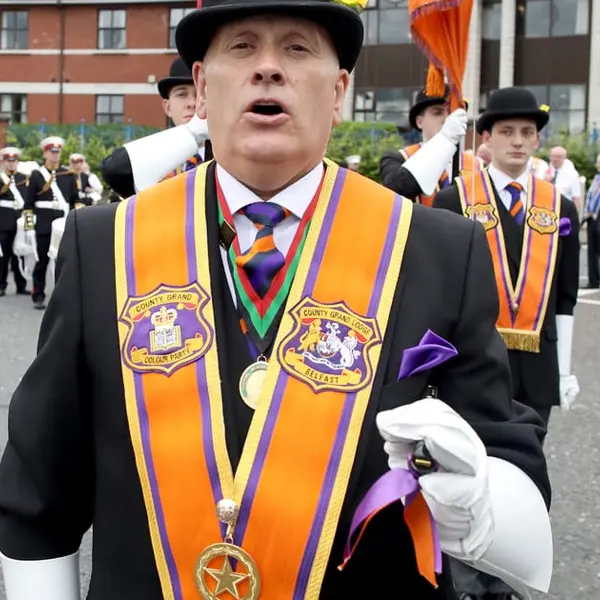
As we have seen, the class interests of the Orange Order always lie with the landowners and bosses. The bowler hats, white gloves and collarettes might make its members look the same. But all this does is hide the material reality below the surface. Orangeism has always been a ruling-class ideology, designed to flatten class-consciousness, both with words and violence. It has been instrumental in keeping unionism alive and allowing Northern capitalism to continue almost unchallenged.
As Karl Marx himself wrote: “The ideas of the ruling class are in every epoch the ruling ideas, i.e. the class which is the ruling material force of society, is at the same time its ruling intellectual force. The class which has the means of material production at its disposal, has control at the same time over the means of mental production, so that thereby, generally speaking, the ideas of those who lack the means of mental production are subject to it. The ruling ideas are nothing more than the ideal expression of the dominant material relationships, the dominant material relationships grasped as ideas; hence of the relationships which make the one class the ruling one, therefore, the ideas of its dominance.”
The North is in a dire state. 1 in 5 children live in poverty. Rents have risen 51% over the past 5 years. 50,000 families are on a waiting list for social housing, while no new social houses are being built. To top it all off, energy prices are due to rise again this winter. Both communities, from the Garvaghy Road to the Shankill are deeply affected by these issues and more. Reopening disputes like Drumcree does nothing but help draw attention from the hardship we all face as a class. Hardships created and maintained by the capitalist class, who are profiting from our difficulties.
Clinging to orangeism offers us nothing. It has never had any interest in materially improving the lives of working-class Protestants and that isn’t going to change. All it does is distract us from our shared struggles and preserve the status quo of exploitation, poverty, division and confusion. The lessons of the past must finally be learned. Protestant workers must break with orangeism and no longer allow it to trick us back into the arms of our own exploiters.
As we have seen, cross-community unity terrifies the bosses. So that is exactly what we must aim to rebuild. Only together can we free ourselves of the profiteering dictating the course of our lives. But we must push further than they did in 1919. Only with workers fully in the driving seat can we destroy the bonds of sectarian hatred and free ourselves from its corrupting influence. That is the future we are fighting for.
 RED NETWORK